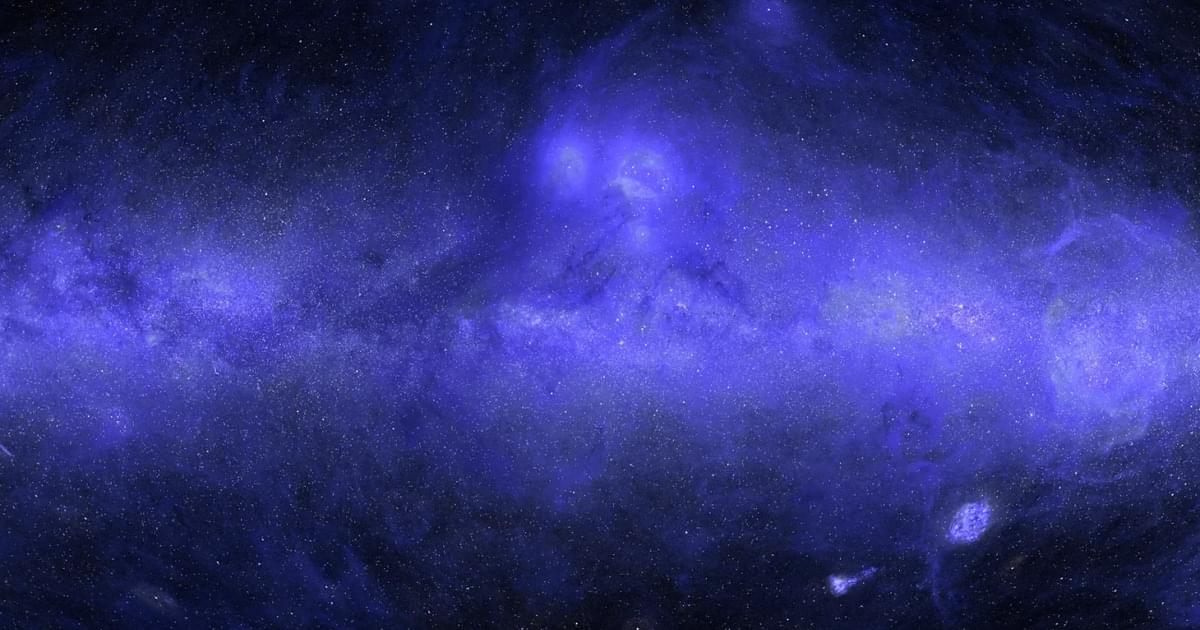
Anthropic released a study demonstrating how autonomous AI agents using Claude generated the first complete, seamless map of the entire sky in ultraviolet (UV) light.
While complete all-sky maps have long existed in visible, infrared, radio, and X-ray spectrums, UV astronomy faced a major bottleneck: Earth’s atmosphere absorbs ultraviolet light, requiring space telescopes like NASA’s GALEX and Swift. Because those missions only surveyed targeted regions, roughly one-third of the celestial sky had never been observed in UV, leaving the existing data fragmented with blank spots and calibration artifacts.
How Claude Created the Map.
Rather than simply generating an image, Claude acted as an orchestrator across a complex scientific data pipeline:
1. Data Ingestion & Cleaning: Claude ingested decades of public observation data from space missions—including NASA GALEX, Swift-UVOT, SPEAR/FIMS, and star catalogs from ESA’s Gaia mission.
2. Artifact Correction: The system diagnosed and fixed systematic errors across 38,000 individual telescope observations—such as stray atmospheric glow and bright star contamination—which human teams hadn’t standardized due to sheer volume.
3. Statistical Inpainting: To fill the unobserved third of the sky, Claude used multi-wavelength templates (combining dust maps and stellar catalogs) to predict the missing UV emission. When cross-referenced against ground-truth test regions, its predictions were accurate to within 10%.
Key Astronomical Discoveries Revealed.
Ultraviolet light traces hot, high-energy phenomena in the universe that visible light misses. The completed map highlights several cosmic structures across the Milky Way:
* Interstellar Dust Illumination: The map reveals massive, diffuse interstellar dust clouds catching and scattering starlight from young, hot stars.
* Stellar Remnants & Supernova Shells: Circular rings and expanding shells left behind by ancient stellar explosions were made continuously visible across regions previously cut off by observational gaps.
* Magellanic Bridge Details: Streams of gas and stellar formation connecting the Milky Way to its satellite galaxies (the Magellanic Clouds) are now traceable in unified UV intensity.
Broader Significance.
This project highlights a shift in how AI is used in scientific research. Rather than making speculative discoveries, AI agents were deployed to execute long-backlogged, labor-intensive data processing tasks that human researchers rarely have the time or funding to manually complete.
Notes:
1. UV vs. Visible & Infrared Sky Maps.
Different wavelengths of light reveal entirely distinct physics in the universe because different cosmic phenomena emit radiation at specific energies.
Wavelength band phenomena observed advantage major curb.
Visible Light Main-sequence stars (like our Sun), mature stellar populations, optical gas nebulae. Standard baseline; uninhibited ground based imaging thru atmospheric windows.
Heavily blocked & obscured by dense inter stellar gas along galactic plane.
Infrared (IR) Cool stars, red giants, planet-forming disks, early distant galaxies, dust lanes. Penetrates through interstellar dust to reveal hidden objects & cooler matter. Blurs young star-forming regions w/ background thermal emissions fr. warm dust.
Ultraviolet (UV) Massive young stars (O/B type), starburst zones, white dwarfs, supernova remnants. Acts as a direct tracer for recent star formation & high-energy thermal processes.
Absorbed almost entirely by Earth’s atmosphere; requires space-borne intruments.
What UV Light Specifically Uncovers.
* Traces Active Star Formation: Massive hot stars emit the vast majority of their light in the UV spectrum. Mapping UV emission provides a direct snapshot of where stars have formed within the last few million to hundred million years.
* Dust Scattering & Fluorescence: Instead of just blocking light, ambient dust grains scatter UV photons from nearby hot stars, lighting up diffuse interstellar structures in a way visible and infrared maps miss.
2. Technical Details of Claude’s Multi-Agent Science Pipeline.
To process tens of thousands of raw observations and build an all-sky map, Anthropic structured Claude into an autonomous multi-agent pipeline using tool calling, Python code execution, and statistical validation loops.
1. Data Normalization & Ingestion Agent: Harmonizing heterogeneous instrument architectures.
* Cross-Catalog Calibration: Standardized spatial coordinates and flux measurements from disparate space archives (NASA GALEX, Swift-UVOT, SPEAR/FIMS) into a unified HEALPix sky-tiling pixel grid.
* Astrometric Alignment: Aligned positional measurements against precise reference catalogs from ESA’s Gaia mission to eliminate geometric distortion across image edges.
2. Artifact Diagnosis & Cleaning Agent: Automated signal filtering.
* Airglow & Background Removal: Identified and subtracted non-cosmic UV interference caused by residual geocoronal atmospheric airglow in Earth-orbiting telescope telemetry.
* Star Masking & Saturation Fixes: Detected saturated bright stars and diffraction spikes, applying localized masking algorithms to isolate genuine cosmic diffuse background emission.
3. Statistical Inpainting Agent: Predictive cross-wavelength estimation.
* Multi-Wavelength Correlations: Leveraged optical and infrared dust maps (from Planck and WISE) as spatial templates to model the relationship between dust density and scattered UV light.
* Bayesian Flux Inference: Generated probabilistic predictions for unobserved sky regions, filling observational gaps while preserving physical signal-to-noise thresholds.
4. Validation & Uncertainty Quantifier Agent: Verifying prediction bounds.
* Blind Cross-Validation: Masked out known high-quality UV observation fields and tasked the model with predicting those regions from scratch, verifying flux predictions within a 10% error margin.
* Uncertainty Mapping: Produced a pixel-by-pixel error map alongside the final sky map, ensuring astrophysicists can distinguish real astronomical signals from model uncertainties.
https://www.anthropic.com/research/the-missing-map-of-the-sky https://menard.pha.jhu.edu/uvmap/
#astronomy #artificialintelligence #DataVisualization #AutonomousAgents
Claude Science to produce the first complete map of the sky in UV light. The map will be a valuable educational tool, allowing students to see in detail the rich structure of the Milky Way visible at this wavelength.