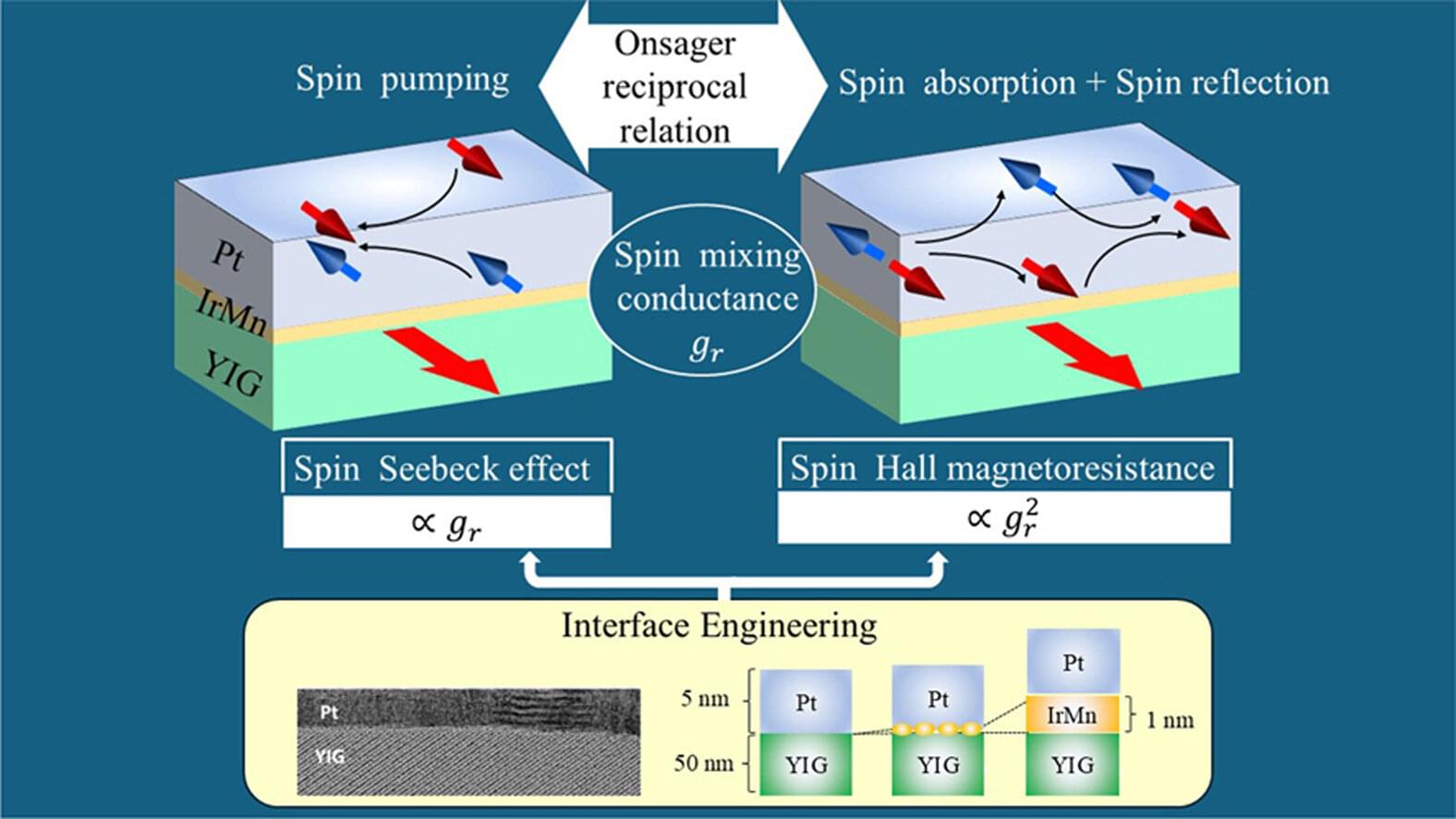
Researchers at Kyushu University have found that an ultrathin layer of iridium manganese (IrMn) can improve two spin-related signals in a structure made of a magnetic insulator and a platinum film. By examining how spin currents are generated and absorbed, the team gained insights into how the intermediate layer improves spin transfer. The findings could inform the development of ultralow-power devices for computing and energy harvesting.
Spintronics is a more complex approach to conventional electronics that uses electron spin, in addition to electrical charge, to process and transmit information. For decades, researchers have been investigating various ways to use spin-related phenomena in computing, data storage and energy harvesting.
One such phenomenon is the spin Seebeck effect (SSE), in which a temperature difference across a magnetic material generates a spin current that can be converted into electricity. Another one is spin hall magnetoresistance (SMR), where a metal’s electrical resistance changes depending on the relative orientation of the electrical current and the magnetization of a neighboring magnetic layer. If harnessed effectively, the SSE could provide a way to recover energy from heat that would otherwise go unused, and SMR could prove useful for data storage and computing.