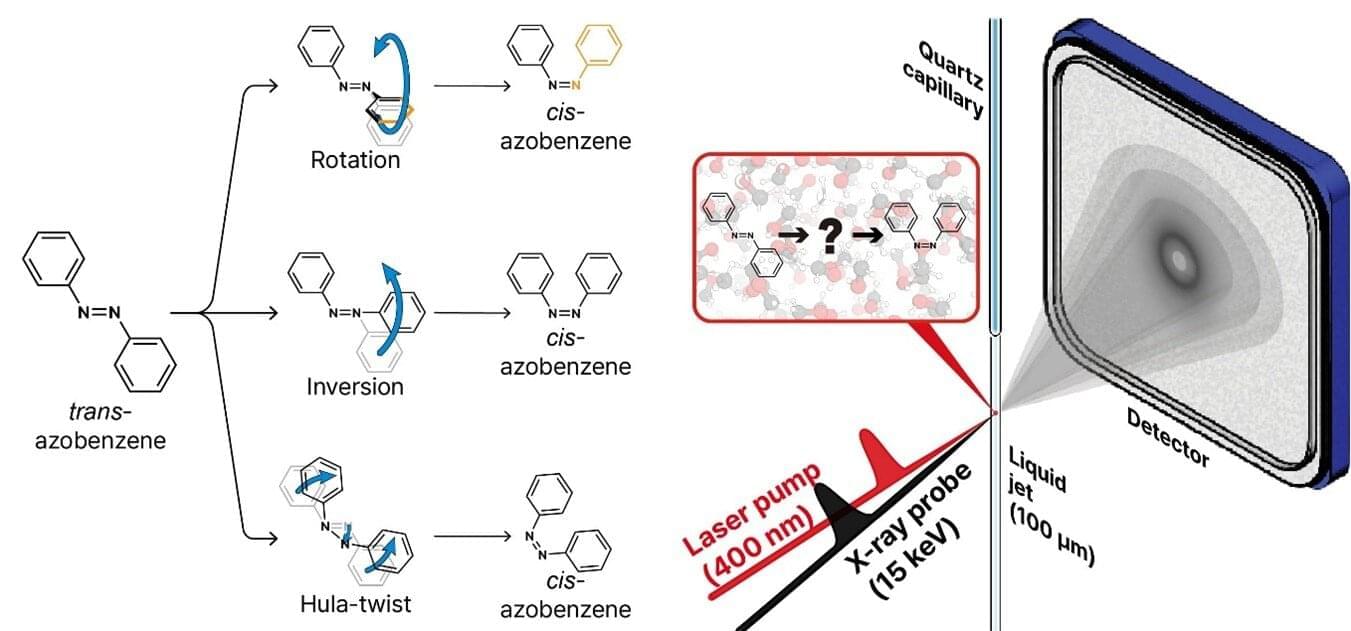
Azobenzene is one of the best-known molecules that can be switched between two forms by light. However, the question of how the molecule moves in the first few picoseconds (trillionths of a second) after it absorbs light has remained unresolved for nearly 50 years.
A research team led by Hyotcherl Ihee, professor in the Department of Chemistry at KAIST and director of the Center for Advanced Reaction Dynamics (CARD) at the Institute for Basic Science (IBS), has identified the process by which the light-responsive molecule azobenzene changes its structure.
The team has shown that, during the initial stage of the reaction, the molecule changes shape through a coordinated motion of the two nitrogen atoms at its center, while its two benzene rings stay nearly in place. The finding is expected to provide useful information for designing materials and molecular-scale machines that operate with light.