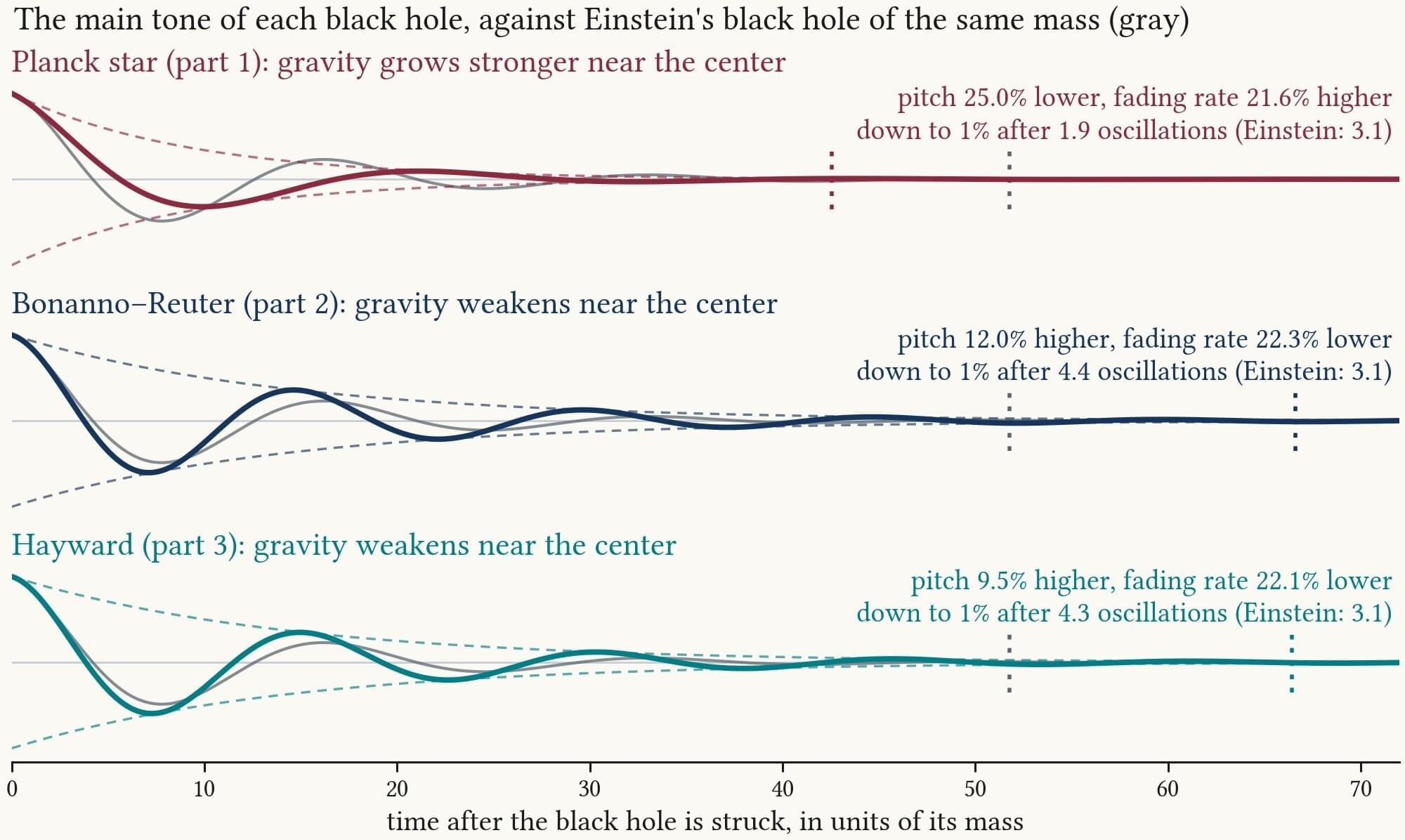
Every black hole hides a question at its center. Einstein’s theory predicts that whatever falls in is crushed into a singularity, a point of infinite density where the theory itself breaks down. Most physicists expect quantum gravity to replace that point with something finite. But the center lies hidden behind the horizon. How could we ever learn what is there?
One answer is to listen. A disturbed black hole, for instance, one just born from a merger, rings like a struck bell, shedding gravitational waves in a few quickly fading tones that physicists call quasinormal modes. Each tone has a pitch and a fading rate, set by the shape of spacetime around the black hole. Build the center differently, and the black hole should ring differently.
Over the past year, my colleague Davide Batic and I, with Fabio Scardigli for the first two papers, computed these tones for three black holes whose centers are reshaped by ideas from quantum gravity. Our third paper, now published in Physics of the Dark Universe, completes the series, and the answers fall into a simple pattern: where gravity weakens at short distances, the black hole rings higher and longer; where it grows stronger, it rings lower and dies away sooner.