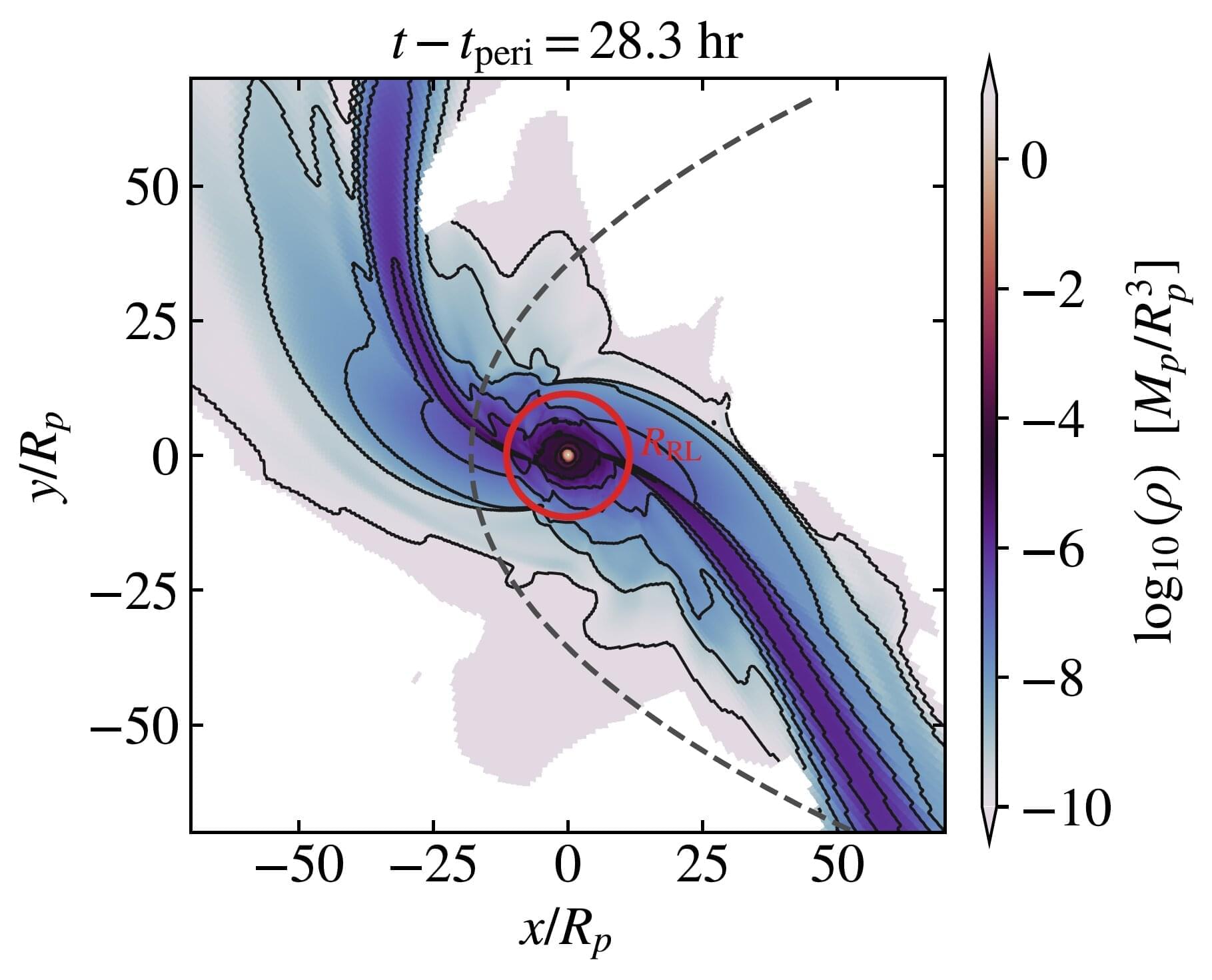
Using advanced new simulations, a team of astronomers in the U.S. has developed a promising new theory for how giant, gaseous exoplanets migrate into stiflingly close orbits around their host stars. Led by J. J. Zanazzi at The Pennsylvania State University, the team showed how both massive “hot Jupiters” and smaller, Neptune-sized planets could migrate from distant, elliptical orbits as they release energy via dramatic shock waves in their outer atmospheres. Their results have been published in The Astrophysical Journal.
Hot Jupiters are a class of exoplanets with masses comparable to the largest planet in our own solar system, but which orbit extremely close to their host stars—imparting them with temperatures that can exceed some 2,000 Kelvin. Not only are their orbital periods extremely short, they also cluster within a window between three and five days: a phenomenon dubbed the “hot Jupiter pileup.”
Similar clustering can also be seen in smaller gas giants, with masses between those of Neptune and Saturn, known as the “Neptune ridge.” Yet unlike hot Jupiters, these planets are strikingly scarce on orbits shorter than about three days, creating a stark observational gap named the “Neptune desert.”