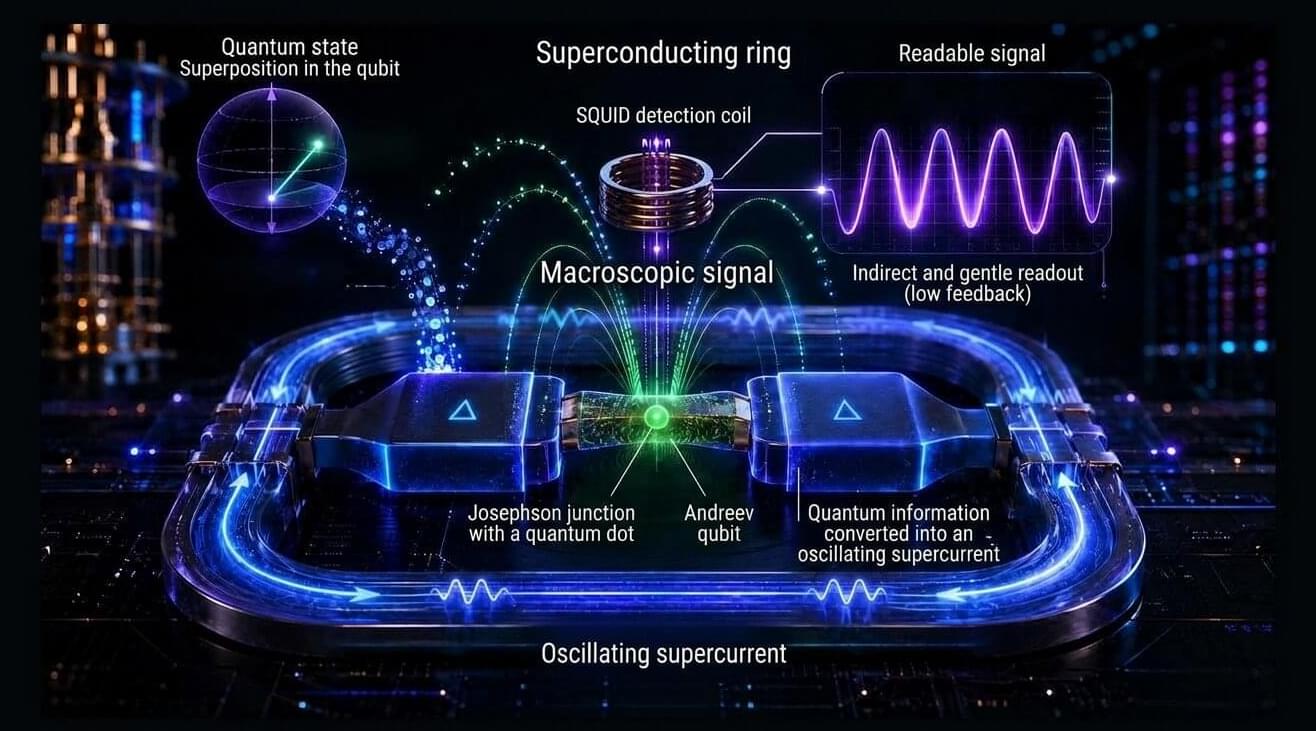
One of the fundamental challenges of quantum computing is obtaining information from a quantum bit, or qubit. Unlike a conventional bit, which can be read repeatedly without altering its content, direct measurement of a quantum system typically causes the state to collapse before it can be determined. In other words, reading the information modifies it.
A new study proposes circumventing this problem by using a unique property of a certain type of qubit called an “Andreev qubit.” This qubit produces an oscillating electric supercurrent through its own quantum dynamics. This supercurrent would serve as a macroscopic indicator of the qubit’s state, enabling its reconstruction in a virtually nondestructive manner.
The study was published in the journal Physical Review B and was led by José Carlos Egues, a full professor at the São Carlos Institute of Physics at the University of São Paulo (IFSC-USP) in Brazil, and Yugui Yao of the School of Physics at the Beijing Institute of Technology in China. According to the authors, this method could eliminate the need for ancillas, auxiliary qubits used in current techniques for nondestructive quantum readout.