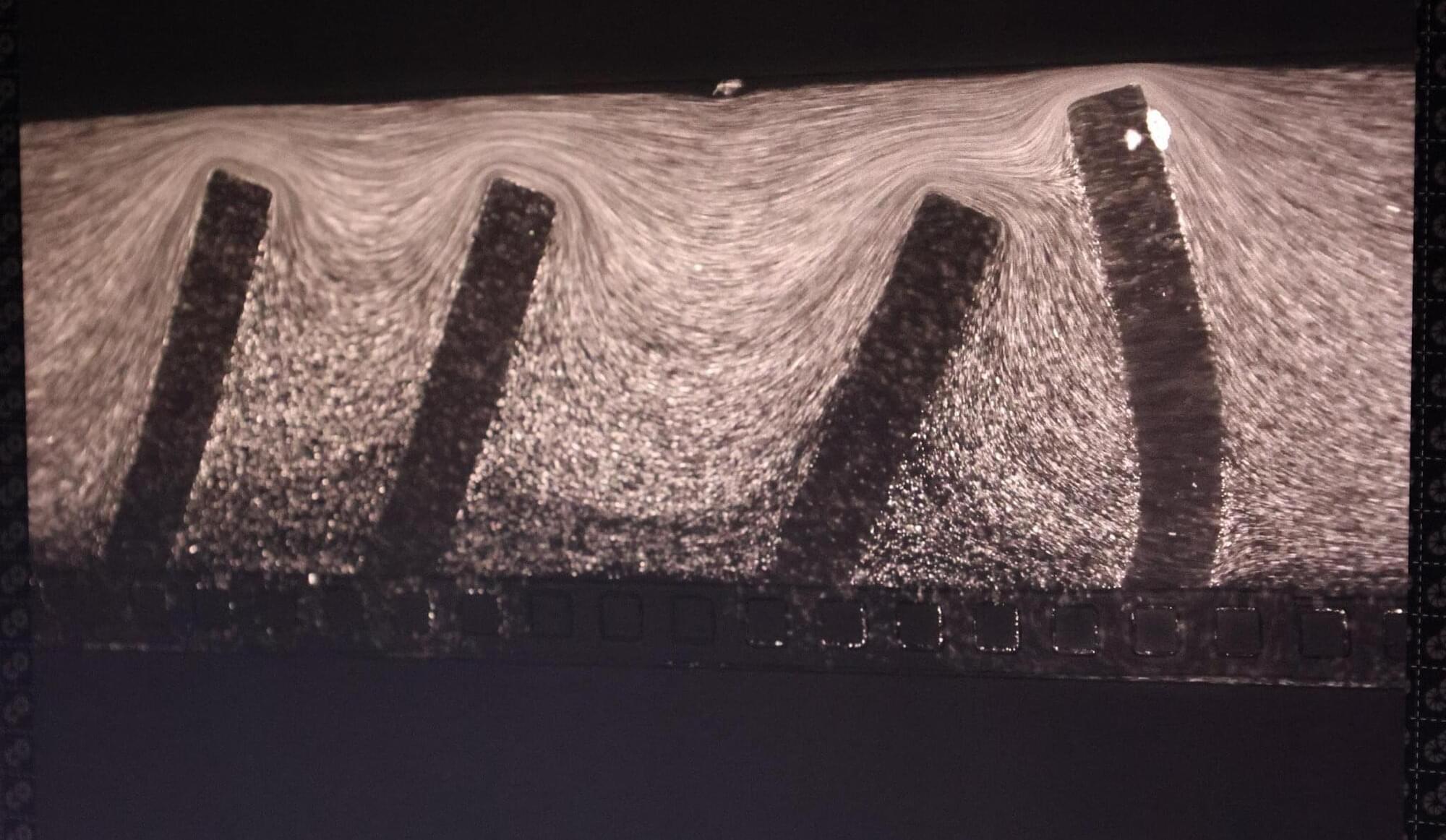
Like the folds in crumpled sheets or the footprints on recently trodden sand, certain materials mark their histories. Now, Yale researchers show that networks of flowing water and other fluids can store their own memories—similar to how a computer chip does—an innovation that could steer robots and provide insight into some simple organisms. The results are published in Physical Review X.
In Professor Amir Pahlavan’s lab, researchers created a small chip with multiple tiny channels, each with a depth about half the width of a human hair. Inside these channels, they placed a series of flexible microfibers that stand in the way of the fluid flowing through the channels. Pressure from the flow can cause the fibers to switch between two states, affecting how the fluid passes.
This forms a “memory” of past flows, making each fiber’s current state depend on its history and, when coupled, on the states of other fibers. The two stable configurations of each fiber can represent a zero or a one, much like a bit in computer memory.