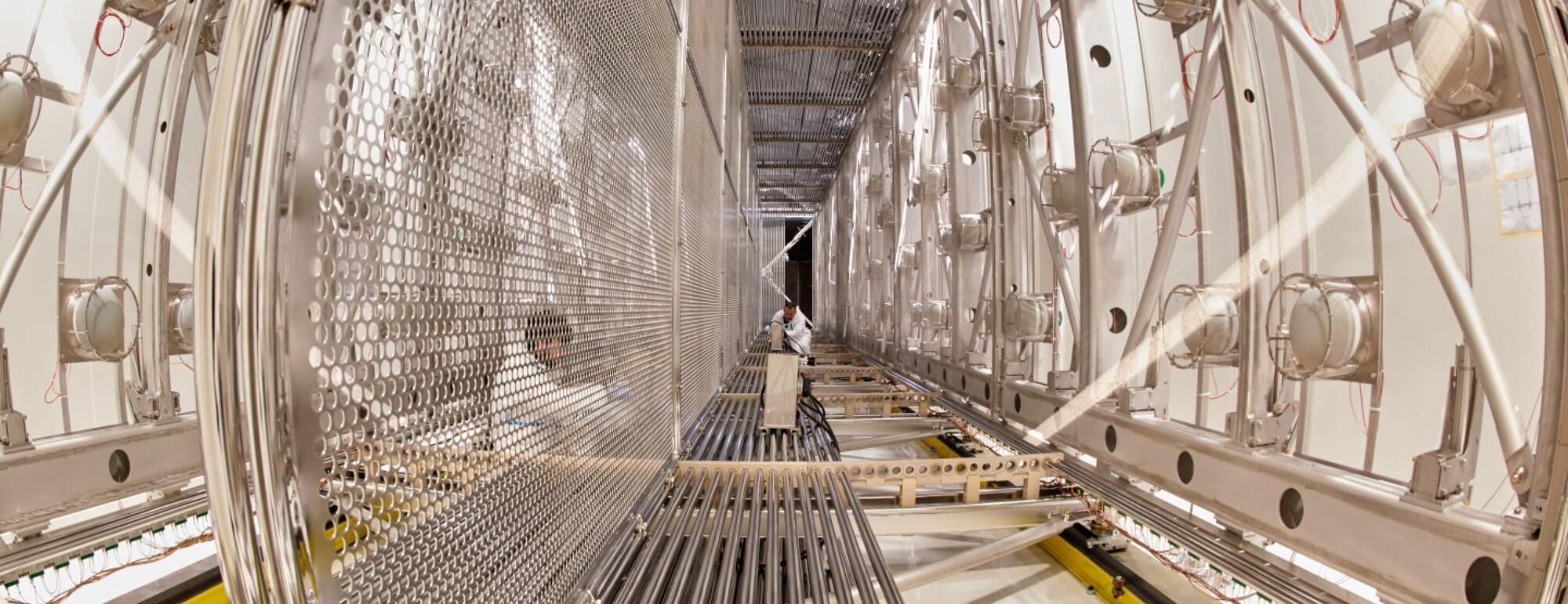
Neutrinos are among the most abundant particles in the universe, but they are also among the most elusive. Nearly massless, they are produced by nuclear reactions in the sun, exploding stars, particle accelerators and even the decay of radioactive elements on Earth. They interact so weakly with ordinary matter that trillions pass through each person every second without leaving a trace. Studying these ghostly particles could help answer some of the biggest questions in physics, from the nature of dark matter to why matter exists at all.
Because neutrinos are so elusive, scientists build enormous detectors and intense particle beams to catch even a small number of them in action. But capturing a neutrino interaction is only the beginning. Scientists must then reconstruct what happened from an extraordinarily complicated picture of particle tracks, overlapping signals and background activity. Researchers at the Department of Energy’s (DOE) SLAC National Accelerator Laboratory have developed a machine-learning program called SPINE to tackle this challenge.
SPINE, which stands for Scalable Particle Imaging with Neural Embeddings, analyzes data from liquid argon time-projection chambers, the detector technology used by experiments including the Short-Baseline Neutrino program at the DOE’s Fermi National Accelerator Laboratory in Illinois and the Deep Underground Neutrino Experiment (DUNE), currently under construction in Illinois and South Dakota and expected to start taking data in 2030. SPINE learns from simulated detector images to identify particles, trace their paths and piece together the interactions that produced them.