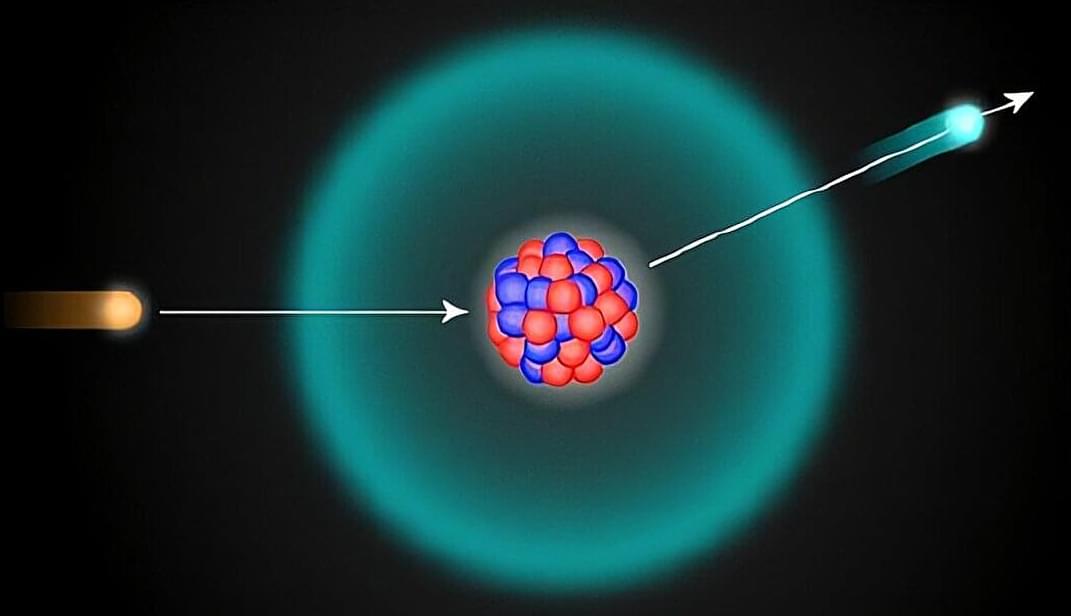
Glimpses of the “gallium anomaly” were first seen in the mid-1990s, but it was first clearly discovered and stated in 2007 by neutrino physicist Carlo Giunti of Italy. The problem is simple to state but potentially very important: about 20% fewer electron neutrinos were seen to be captured by gallium nuclei than expected.
But now the anomaly looks to be explained with a new calculation by a collaboration of physicists at Italian universities and research laboratories—and the calculation agrees with the observed number of electron neutrinos captured. Their work is published in the journal Physical Review Letters.
When an electron neutrino (one of the three types of neutrinos) collides with a neutron in the nucleus of gallium-71 (⁷¹Ga), an electron is produced and the neutron transforms to a proton as a down quark converts to an up quark. The gallium nucleus then becomes a germanium-71 (⁷¹Ge) nucleus. This is a weak force interaction with a W+ particle exchange, a so-called charged-current weak interaction, and was historically important to the solar neutrino problem recognized in the 1960s.