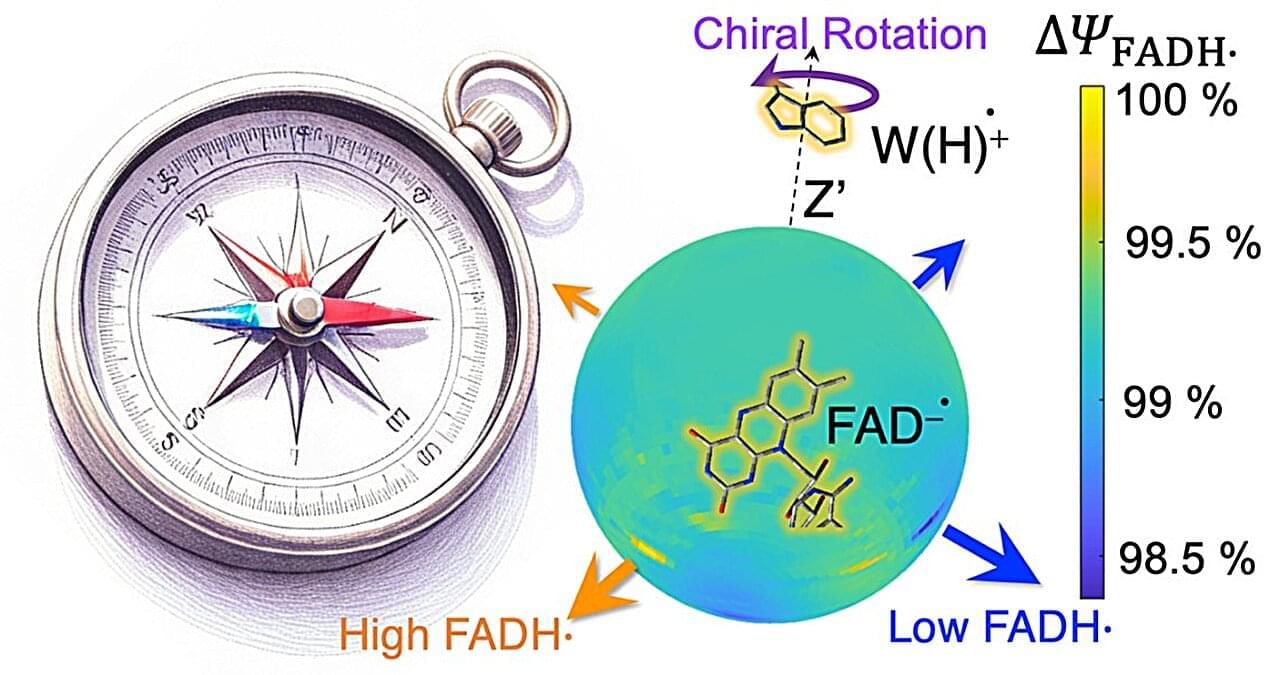
A collaborative research team led by Yasuhiro Kobori at Kobe University, together with researchers from Toho University, Saitama University, Nagoya Institute of Technology and the University of Freiburg, has identified a potential molecular mechanism that could enhance magnetic compass responses in cryptochrome, a blue-light-sensitive protein implicated in magnetoreception.
Using time-resolved electron paramagnetic resonance (EPR) spectroscopy, the team identified structural rearrangements in light-induced intermediates and a contribution from chirality-induced spin selectivity (CISS). Their analysis suggests that chiral rotational motion of a tryptophan residue can influence electron-spin polarization and enhance the directional dependence of downstream chemical reactions.
Their findings are published in The Journal of Physical Chemistry Letters.