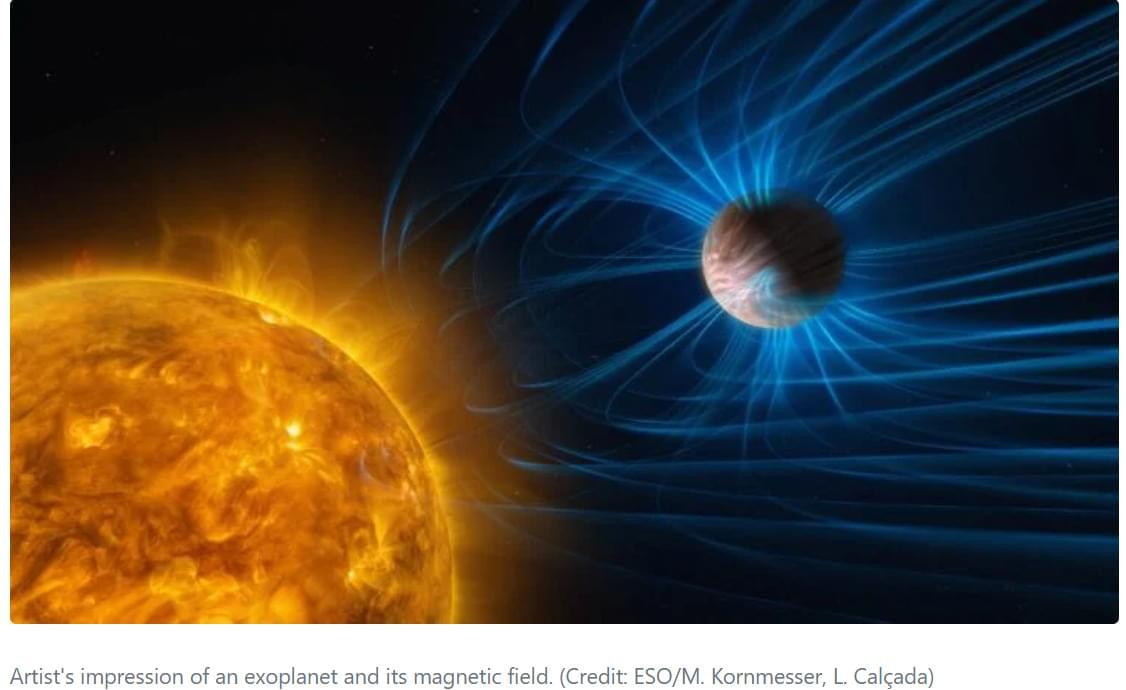
Studying exoplanets has given astronomers insights into the characteristics that could help them find life beyond Earth. For years, astronomers thought an exoplanet’s location in a star’s habitable zone was enough to make it an Earth-like world. But some stars are more active than our sun, exposing planets in their habitable zones to far more radiation than Earth receives. Astronomers have increasingly recognized that a planet’s magnetic field, which shields Earth from harmful radiation, could be a key characteristic in identifying Earth-like worlds.
Now, an international team of scientists is shedding light on how to study exoplanet magnetic fields in a chapter published in Advancing Astrophysics with the SKA II, a 2026 science book sponsored by the Square Kilometer Array Observatory (SKAO). The researchers discuss how the SKA could be used to study magnetic fields not only on exoplanets but also on ultracool dwarfs (UCDs). The chapter is also available on the arXiv preprint server.
As their name suggests, UCDs are stars smaller and cooler than our sun. Some are brown dwarfs, objects between Jupiter and the sun in size that did not grow large enough to achieve nuclear fusion.