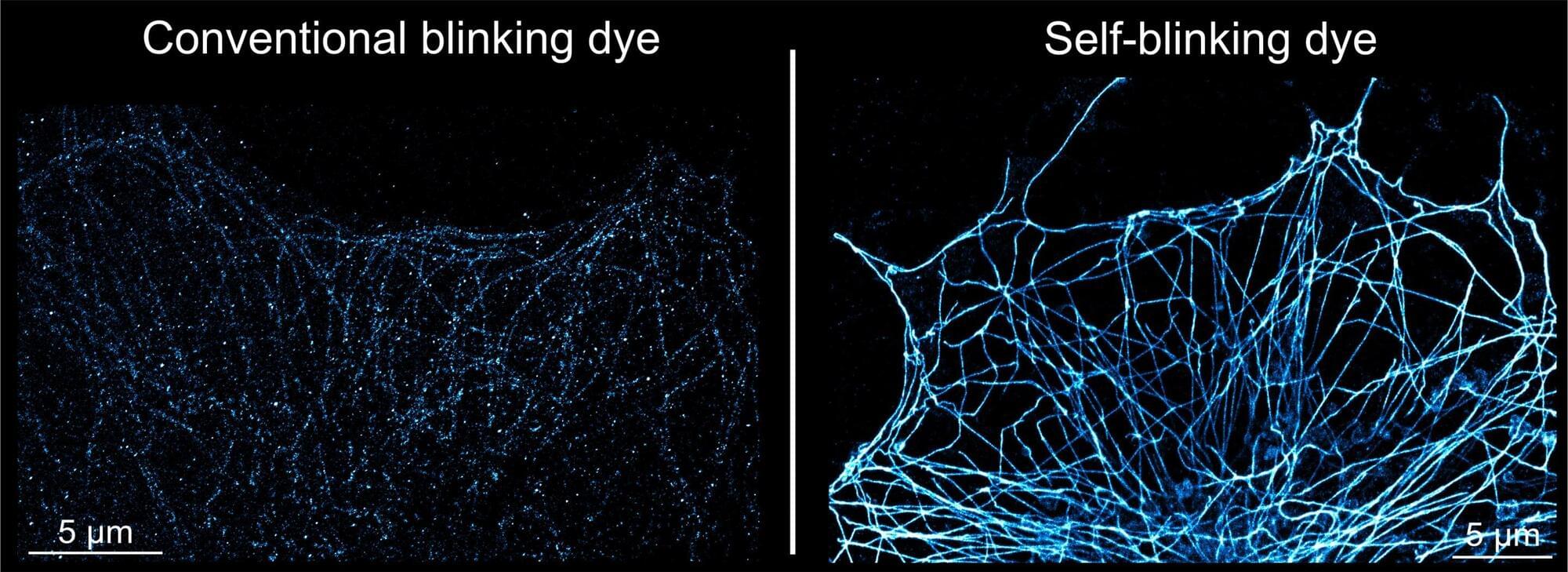
Nanobodies are extremely small antibody fragments that bind to specific molecules. When nanobodies are labeled with dyes, they can be used as probes to enhance super-resolution microscopy. However, conventional blinking dyes often perform poorly when attached to nanobodies, limiting their practical advantages. An international research team led by the University of Göttingen and the University Medical Center Göttingen (UMG) has now shown that self-blinking dyes—which can switch between bright and dark states on their own—bypass this limitation.
The new approach combines the high labeling accuracy of nanobodies with the robust and straightforward imaging enabled by self-blinking dyes—simplifying experiments, improving reproducibility and increasing the throughput of super-resolution microscopy. The results are published in Nano Letters.
A self-blinking dye is a fluorescent molecule that switches spontaneously between a bright “on” state and a dark “off” state. This blinking is essential for super-resolution microscopy because it allows individual fluorescent molecules to be detected one after another and localized very precisely.