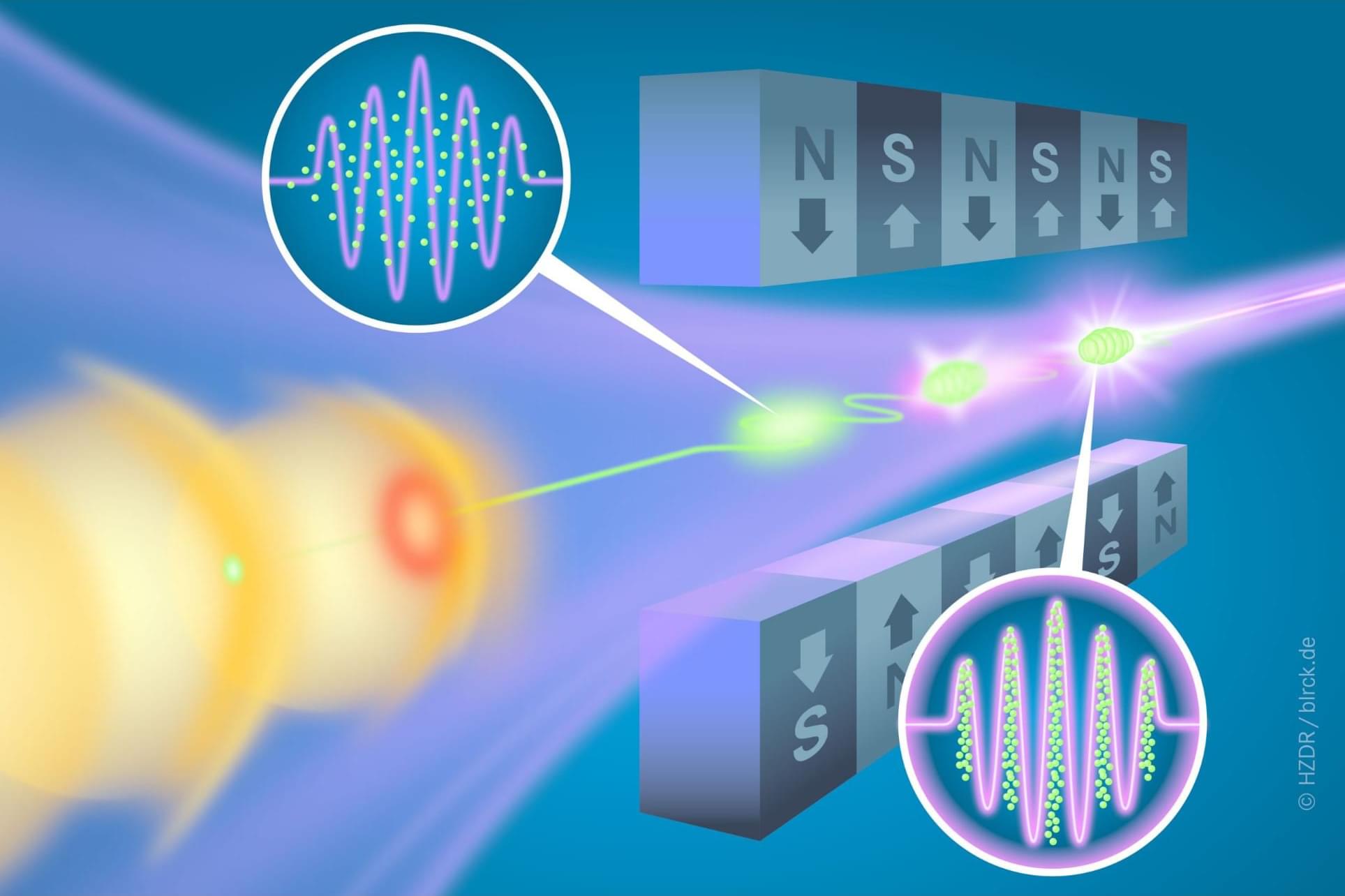
Researchers take a step toward smaller, more affordable free-electron lasers.
Scientists studying atoms, molecules, and new materials use light a little like a photographer uses a camera flash, illuminating their subjects with extremely brief, intense bursts. These flashes come from machines called free-electron lasers, or FELs, and demand for experiments at the large facilities that house them often leaves researchers facing long waits.
Researchers at the Helmholtz-Zentrum Dresden-Rossendorf (HZDR) in Germany and Synchrotron SOLEIL near Paris have now overcome a reliability problem in a compact design that could eventually help meet this demand. Writing in Physical Review Letters, the team reports the first stable, reproducible operation of a laser-plasma FEL in the high-gain regime, a state in which the light it generates undergoes strong amplification.