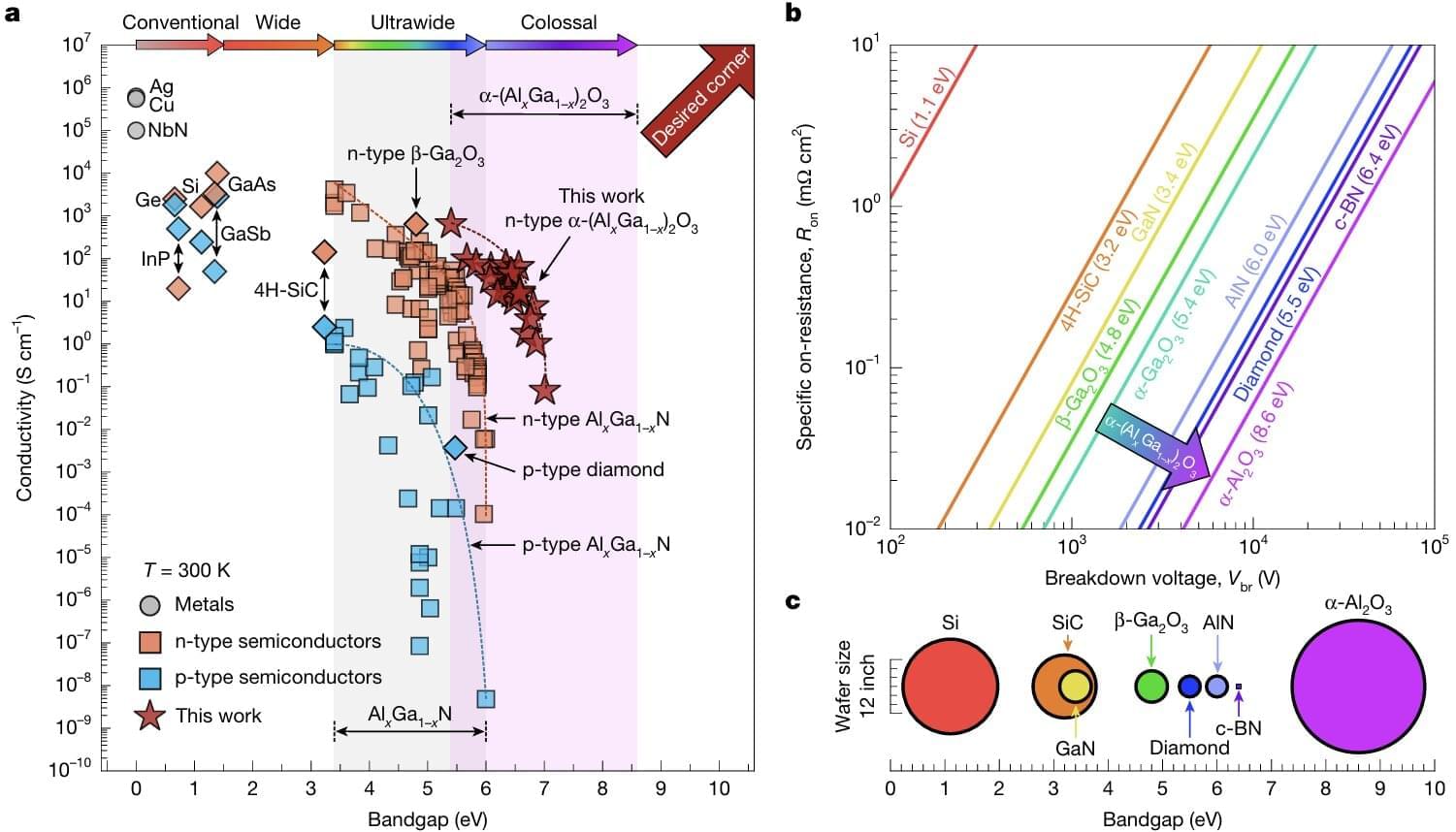
Semiconductors with wider bandgaps could pave the way for smaller, more efficient electronics that can handle far higher voltages, but the wider this gap becomes, the harder it is to control how well a material conducts electricity. Now, a team led by Darrell Schlom at Cornell University has shown that adding silicon to thin films of aluminum gallium oxide can keep this control intact at bandgaps wider than any semiconductor before it. Their research has been published in Nature.
In a semiconductor, electrons occupy two distinct ranges of energy. In the lower “valence band,” they are bound tightly to their atoms and can’t carry a current. If they gain enough energy, however, they can jump into the higher “conduction band,” where they move freely.
A semiconductor’s bandgap describes the energy required for an electron to make this leap and allows semiconductors to be switched between insulating and conducting states. Since wider bandgaps let materials withstand stronger electric fields, wide-bandgap semiconductors like gallium nitride and silicon carbide are already used in everything from fast phone chargers to electric vehicles.