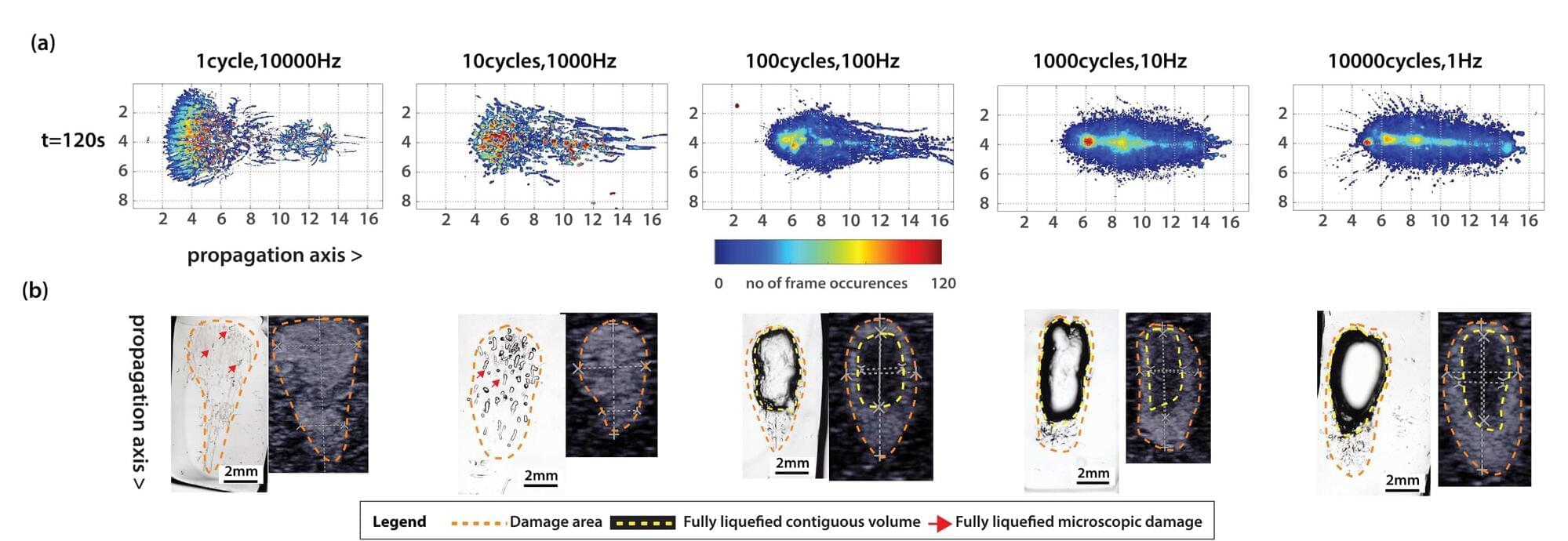
One of the questions that stayed with me throughout my Ph.D. was surprisingly simple: Why are some tissues so much harder to break down with histotripsy than others? Histotripsy is a focused ultrasound technique that uses cavitation bubbles to mechanically break down tissue. Unlike thermal ablation, the goal is not to heat the tissue. Instead, the rapid activity of these bubbles creates mechanical stresses that progressively disrupt tissue structure.
This process can be very effective in many soft tissues. Fibrous tissues, however, can behave quite differently. This was especially interesting to me because my doctoral research was motivated in part by benign prostatic hyperplasia, or BPH tissue can contain substantial amounts of smooth muscle and collagen, and these fibromuscular components can make the tissue mechanically tough and more resistant to histotripsy.
To study that problem in a controlled way, we developed fibrous tissue-mimicking materials that reproduced important mechanical characteristics of prostate tissue and were intentionally difficult to break down. Once we had a material that resisted treatment, another question became increasingly important to me: If we deliver the same overall amount of ultrasound exposure, does it matter how that exposure is distributed in time?