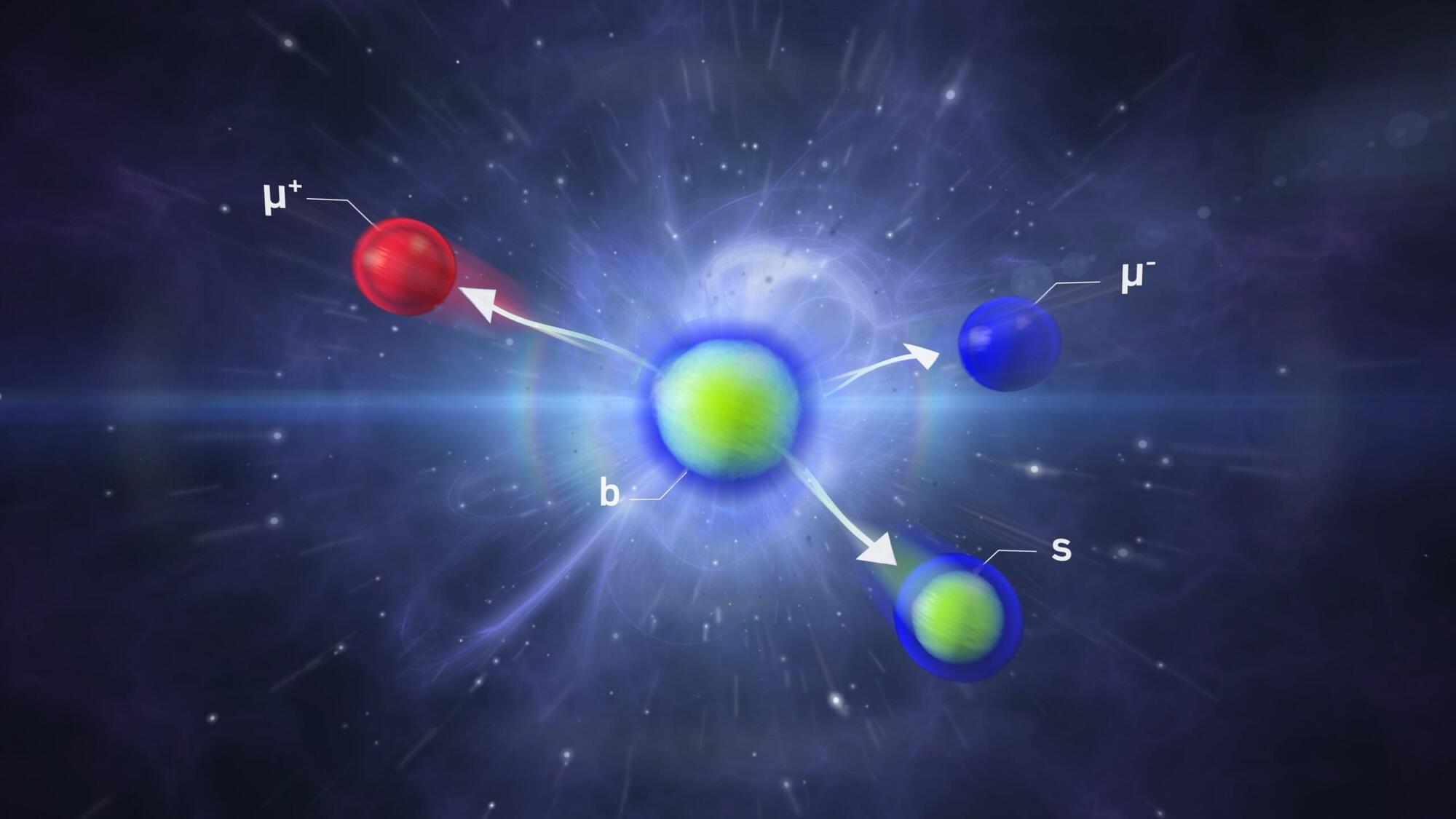
Studying rare processes is part and parcel of particle physics, providing stringent tests of the Standard Model. At the recent International Conference on High Energy Physics (ICHEP), the CMS and LHCb collaborations presented their latest research into one such process: the transformation of a beauty quark into a strange quark, a muon and the oppositely charged antimuon (b→sμ⁺μ⁻).
Flavor transitions—when one type of quark turns into another—can only take place via the weak interaction, one of the four fundamental forces. Quantum physics describes how other particles, not directly involved in a particular transition, can influence how that transition takes place. If a process happens differently than is predicted by the influence of the particles we know about, which make up the Standard Model, this difference could point to the existence of as-yet-undiscovered particles and interactions.
Some of these transitions are extremely rare, which makes them very sensitive to any potential contributions from particles that may exist beyond the Standard Model. The b→sμ⁺μ⁻ transition is one such process, only occurring approximately once in every 10 million decays of particles containing beauty quarks, known as beauty particles. Over the past decade, signs have begun to appear that this transition may not occur as expected.