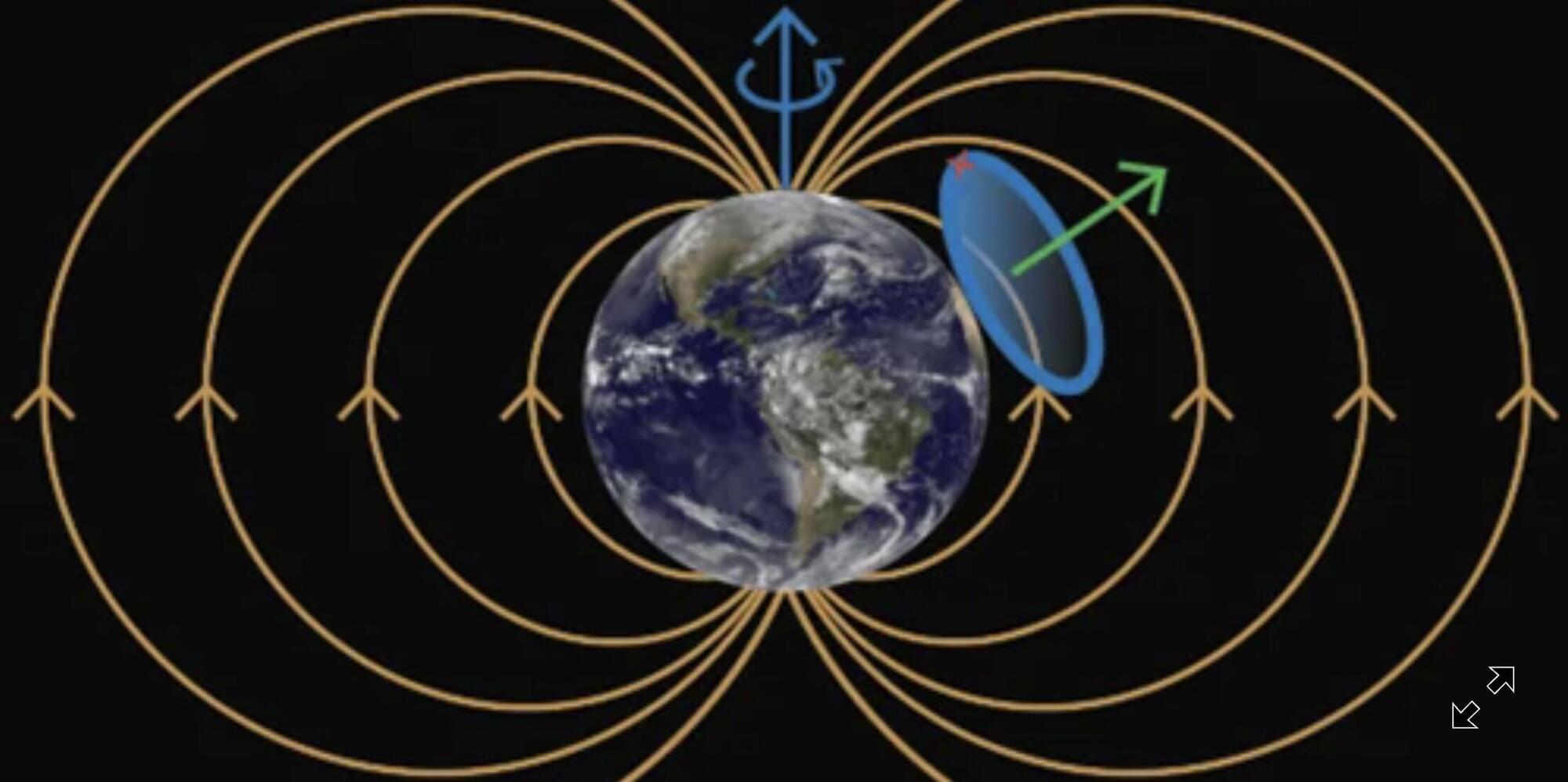
Einstein’s theory of general relativity describes gravity as the bending of spacetime, a mathematical model that combines three-dimensional space and time into a single, four-dimensional continuum. The theory also predicts that a rotating object, such as Earth, slightly drags the surrounding spacetime as it rotates, a phenomenon known as frame-dragging.
Researchers at the University of California, Berkeley (UC Berkeley), the Austrian Academy of Sciences and the California Institute of Technology (Caltech) recently introduced the idea of a quantum sensor that could measure this tiny effect in a laboratory setting. Their proposed experiment, described in a paper published in Physical Review Letters, would use helium cooled until it enters a special phase known as the superfluid state inside a gyrometer, an instrument that measures rotation.
“The inspiration for this project came when Birgitta Whaley and I were visiting Markus Aspelmeyer at the Institute for Quantum Optics and Quantum Information (IQOQI) in Vienna, Austria, during a sabbatical of Birgitta,” Kai-Isaak Ellers, first author of the paper, told Phys.org.