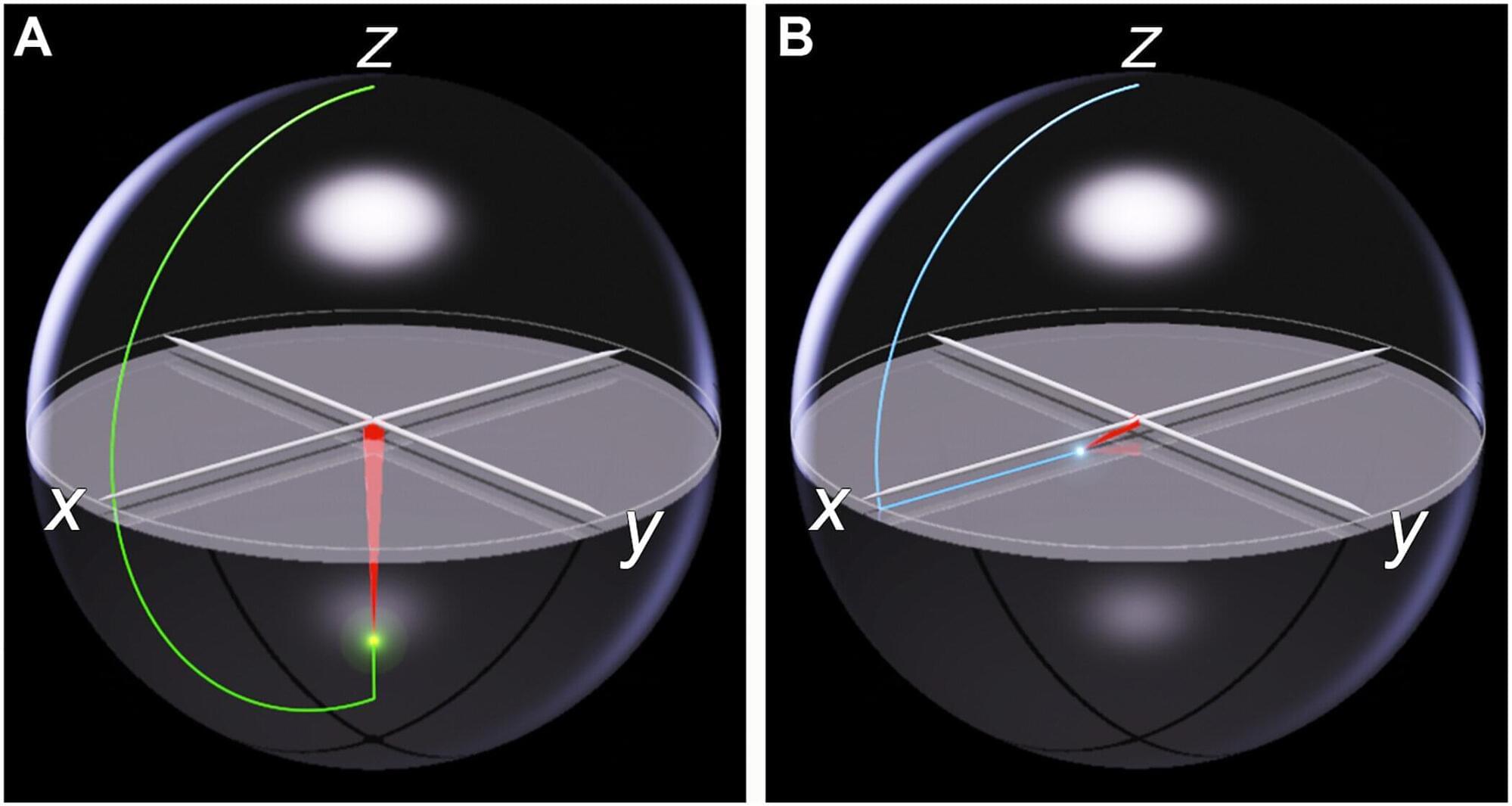
A concept from the field of quantum mechanics, spin is a property of particles that has no direct counterpart in everyday experience. Since the early 20th century, researchers have learned to manipulate it deliberately by means of precisely shaped electromagnetic pulses. This has resulted in two technologies that are widespread today: magnetic resonance imaging (MRI) is commonplace in hospitals, and nuclear magnetic resonance spectroscopy (NMR) is used to determine the structures of proteins and to develop new drugs. The mathematical framework of optimal control theory can be used to improve these technologies.
“The question it answers is a practical one,” explains Christiane Koch, professor of theoretical physics at Freie Universität Berlin. “Given a quantum system and the fields I can apply to it, how do I reach the state I want as quickly, as reliably and as accurately as possible—and how well can it be done at all, in principle?”
The gains are considerable: Pulses designed in this way invert nuclear spins about 10 times faster than the conventional pulses previously in use, and in magnetic resonance imaging they make it possible to build the constraints of a real scanner directly into the design of the experiment.