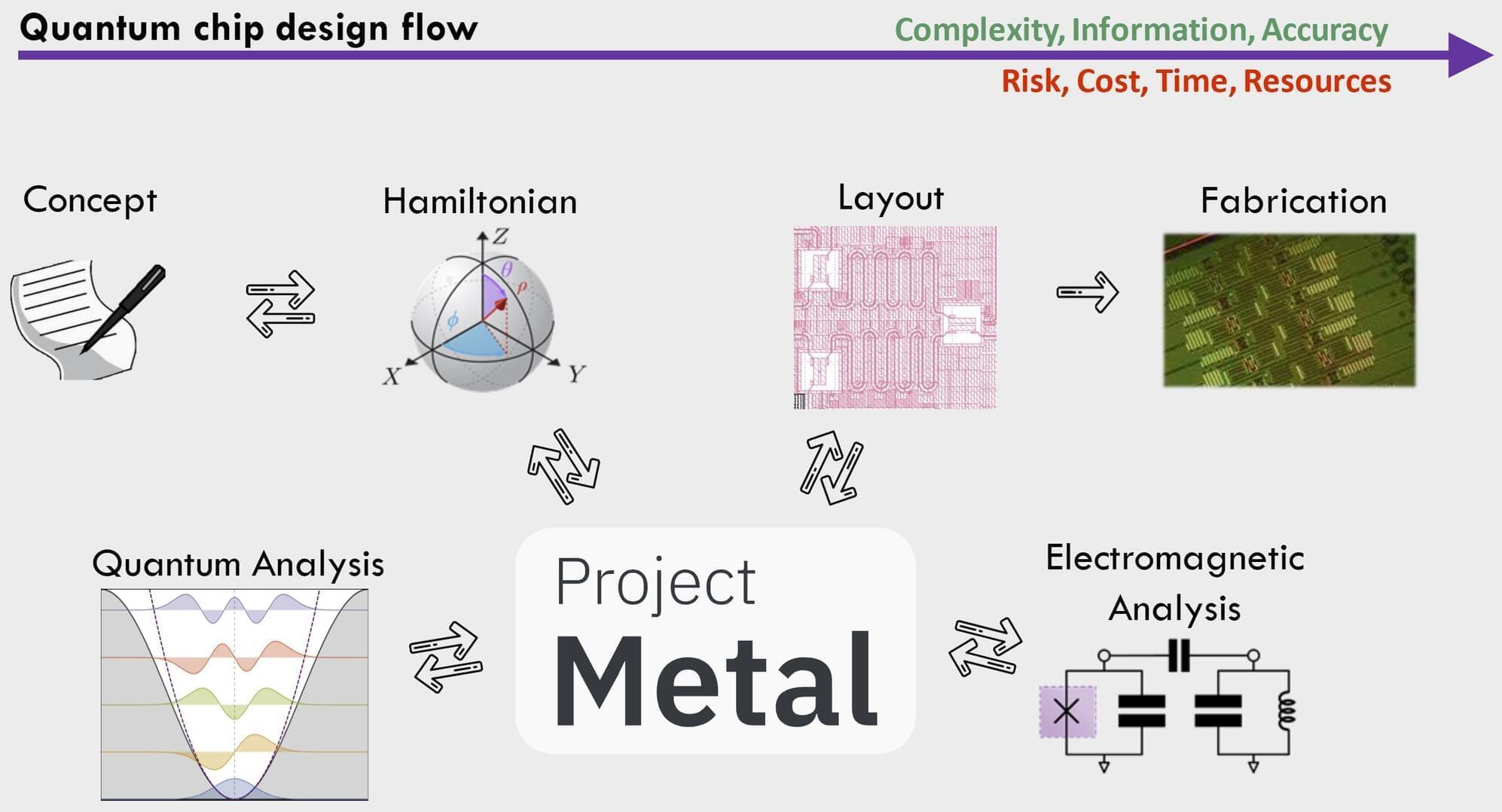
A visual gallery of the Quantum Metal components now — browse the whole library as thumbnails and jump to the docs for each, instead of digging through code. https://qiskit-community.github.io/qiskit-metal/workflow.html.
Quantum Metal Workflow.
Vision.
Quantum Metal is the open-source chip-design layer for superconducting quantum hardware: a Python library where you build a chip from QComponents, attach analyses, and hand the result to whichever solver / fab / orchestrator you want. The library itself is solver-agnostic; the renderers are the integration layer with the outside world (GDS, HFSS, Q3D, gmsh, Elmer, AWS Palace, …).
We sit inside a broader open-source ecosystem — design discovery (SQuADDS), Palace simulation wrappers (SQDMetal, pypalace), mesh utilities, quantization tools. Full map: Ecosystem doc (rendered on the docs site). Items below are about Metal’s own direction; ecosystem-level coordination is tracked alongside.
Two things shape the next year:
1. Lite-by-default. import qiskit_metal should be fast, dependency-light, and never assume Qt / AEDT / gmsh / Palace are present. Heavy backends are opt-in extras.
2. Orchestration-friendly. Quantum Metal is increasingly used inside AI-driven design loops where an LLM or optimization agent generates designs, dispatches them to one or more backend solvers, and iterates on the result. The library’s surface should be predictable, scriptable, and minimal — no GUI prompts, no hidden state, no “did you remember to install AEDT” surprises.
#ChipDesign #superconductors #quantumphysics #python #qiskit
Quantum Metal enables chip prototyping in a matter of minutes. You can start from a convenient Python Jupyter notebook or take advantage of the user-friendly graphical user interface (GUI). Simply choose from a library of predefined quantum components, such as transmon qubits and coplanar resonators, and customize their parameters in real-time to fit your needs. Use the built-in algorithms to automatically connect components. Easily implement new experimental components using Python templates and examples.