Rejuvenation breakthrough: Scientists reverse 60 years of aging in human cells.
Turning Back the Biological Clock.
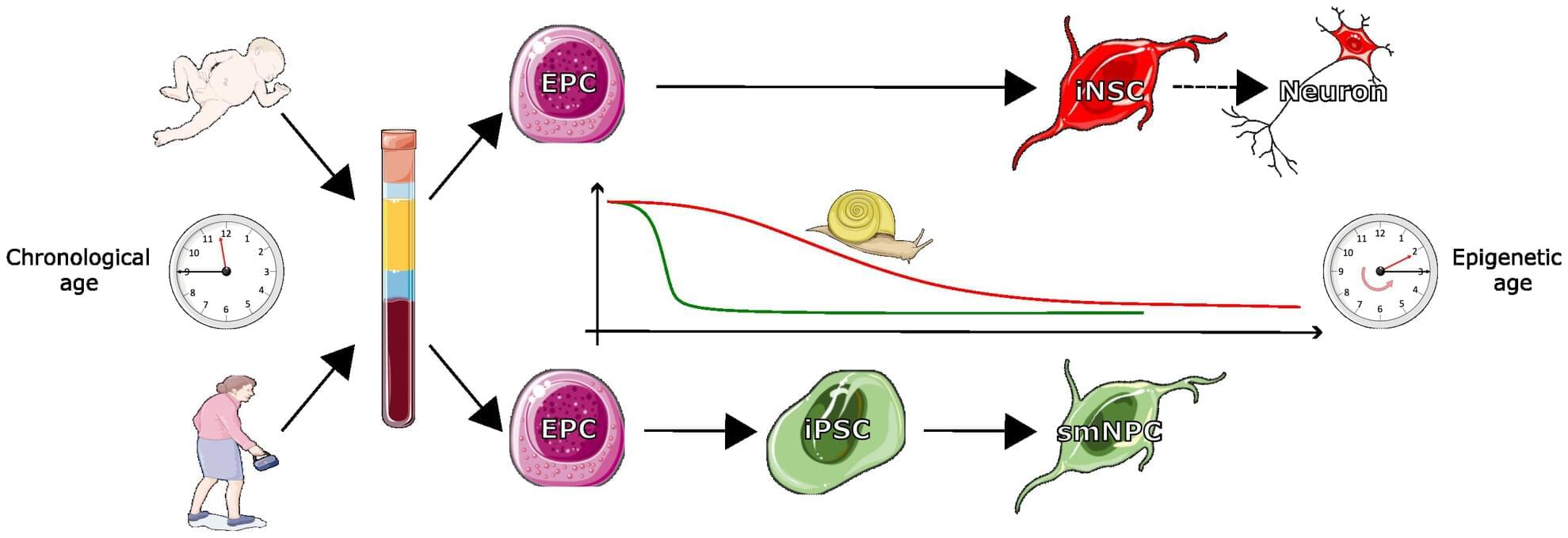
Scientists have long searched for ways to transform ordinary human blood cells into specialized brain stem cells. A major breakthrough in this field is direct conversion—a technique that rewires blood cells directly into induced neural stem cells (iNSCs) using specific cellular master switches (‘SOX2‘ and ‘cMYC‘), completely bypassing the complex embryonic-like pluripotent stage. While researchers knew this process seemed to “wash away” biological aging, key questions remained: How fast does this rejuvenation actually happen, and how completely do these new brain stem cells shed their past?
Key findings: a slow and steady rejuvenation.
To find out, researchers took blood cells from donors across an extraordinary age spectrum—from newborns all the way to a 101-year-old—and turned them into iNSCs. Using epigenetic “aging clock” algorithms that estimate biological age based on DNA modifications, they tracked the transformation over time.
* Dramatic Age Reversal: The blood cells underwent massive epigenetic de-aging. Early-stage converted cells retained only about 13% of the original donor’s age, and as the cells continued to divide, that number dropped to just 5%. A 101-year-old’s blood cell effectively became biologically “young.”
* A Protracted Process: Rejuvenation wasn’t an instant switch. The process unfolded gradually over several weeks—even when cell division was intentionally paused.
* Erasing Cellular History: Over time, the clear differences in gene activity between young-donor and old-donor cells completely faded away. The newly formed neural stem cells shed typical cellular signs of aging, behaving almost identically to pristine stem cells.
* A Hidden Delay in Cell Identity: Interestingly, even after the cells took on the physical appearance and markers of neural stem cells (‘PAX6‘-positive), their underlying genetic and epigenetic blueprints continued to refine themselves for weeks afterward.
Implications.
This discovery reveals that cell transformation and epigenetic age reversal are surprisingly long, continuous journeys rather than quick events. Because this process happens slowly and predictably, it gives researchers a perfect “slow-motion” window to study exactly how human cells erase cellular aging and rewrite their own identity—knowledge that could advance future regenerative medicine and anti-aging therapies.
Key medical breakthroughs & future applications.
* a new source for personalised brain repair.
* The Challenge: The human brain has a very limited capacity to regenerate damaged tissue, and harvesting neural stem cells from living human brains is nearly impossible.
* The Impact: Using a simple blood draw from patients—even those over 100 years old—clinicians could potentially generate patient-specific neural stem cells. Because these cells match the patient’s own tissue, they pose a significantly lower risk of immune rejection if used in cell-replacement therapies.
* reversing cellular aging in degenerative diseases.
* The Challenge: Neurodegenerative disorders like Parkinson’s, Alzheimer’s, and ALS primarily affect older adults whose cells carry decades of accumulated molecular damage and biological age markers.
* The Impact: The study demonstrates that this conversion process wipes away up to 95% of the donor’s epigenetic age. Being able to reset an elderly patient’s blood cells to a biologically “young” neural state means transplanted tissues could be healthier, more resilient, and better able to survive and function inside the brain.
* safer cell therapies without tumor risks.
* The Challenge: Traditional methods often revert cells back to an embryonic-like “induced pluripotent” (iPSC) state before turning them into brain cells. However, iPSCs carry a known risk of forming tumors (teratomas) if any undifferentiated stem cells remain.
* The Impact: Direct conversion bypasses the pluripotent stage entirely, rewiring blood cells directly into neural stem cells. This direct route offers a potentially safer, more streamlined framework for future cell replacement therapies.
* A “Slow-Motion Window” for Drug Discovery & Anti-Aging Therapies.
* The Challenge: Understanding *how* cells naturally erase molecular damage and age markers has been difficult because cellular processes often happen too fast to observe clearly.
* The Impact: Because the de-aging process in this model is protracted (unfolding over several weeks), it provides scientists with an ideal experimental window. Researchers can screen drugs or therapeutic molecules that speed up rejuvenation, prevent cellular aging, or improve the efficiency of tissue repair.
The Road Ahead.
While these findings are a major leap forward, translating them into clinical treatments will require further testing in animal models and human clinical trials to ensure long-term stability, safety, and functional integration of the rejuvenated cells within damaged neural circuits.
#longevity #RegenerativeMedicine #epigenetics #StemCellTherapy #antiaging