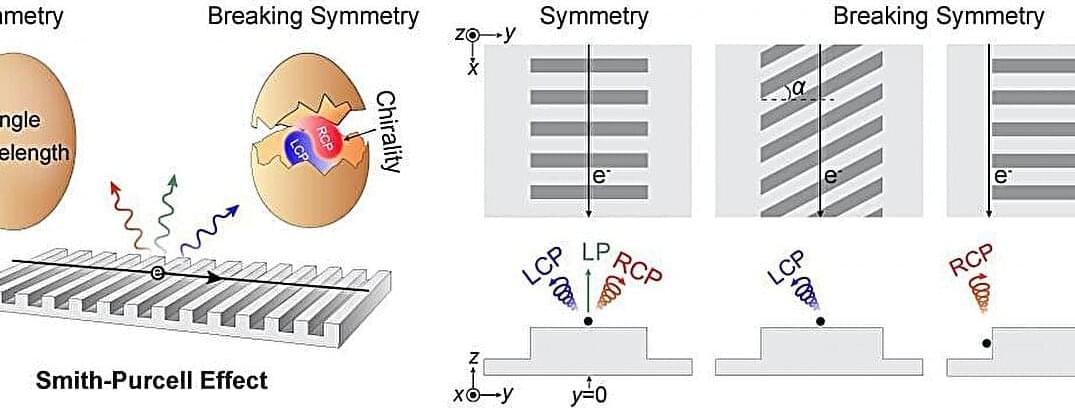
In 1953, two physicists showed that an electron beam skimming past a grating emits light whose color depends only on the electron’s speed and the grating’s spacing. Known as Smith-Purcell radiation, this phenomenon has become a useful tool for building compact, tunable light sources and tracking particle beams without touching them.
Now, researchers from Singapore and China have discovered that this well-studied effect has been hiding a property nobody thought to look for: chirality, or “handedness.” In their paper “Observation of inherent chiral Smith-Purcell effect via symmetry breaking,” published in Nature Communications, associate professors Wu Lin and Dong Zhaogang from the Singapore University of Technology and Design (SUTD) showed that the radiation is inherently chiral and demonstrated two simple ways to bring that chirality out with a plain silicon grating.