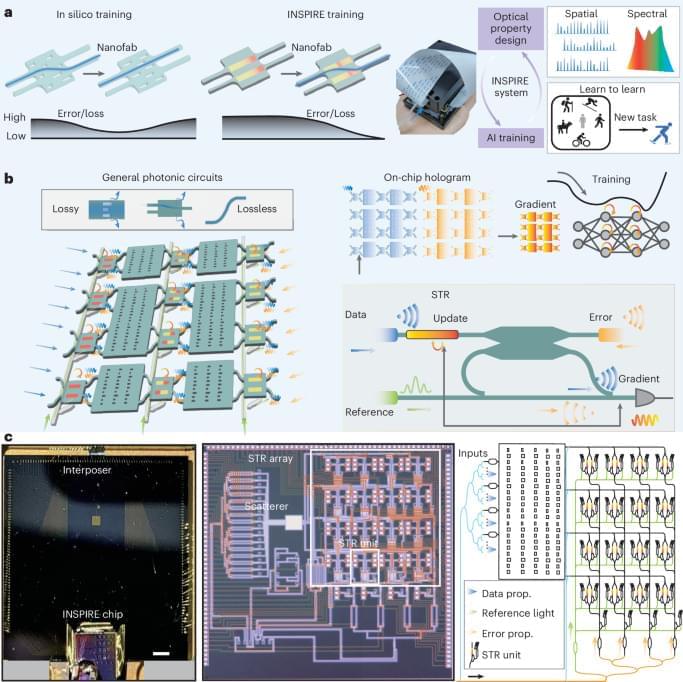
Photonic neuromorphic computing (using light to do neural-network math) promises big speed/energy wins, but there’s a catch: training has almost always happened in silico. You build a digital model of the chip, train it on a GPU, then transfer the weights to the physical device. That approach:
- Requires an accurate physics model of every component (expensive to build and validate)
- Breaks down when fabrication imperfections make the real chip deviate from the model.
- Doesn’t scale well as circuits get larger and more complex.
What INSPIRE does.
INSPIRE (IN-Situ Physical gRadient dEscent) is a general on-chip training method for photonic integrated circuits. The key mechanism is on-chip synthetic time-reversal holography — essentially exploiting optical reciprocity so that the physical system itself generates the gradient information:
1. Forward pass: light propagates through the circuit carrying your input.
2. Gradient measurement: by playing the error signal “backwards” through the same chip (time-reversal), the interference pattern between forward and backward fields reveals the gradient with respect to every tunable element — measured *physically*, not computed from a model.
3. In situ update: the measured gradient directly drives the on-chip tuning elements (e.g., phase shifters), so the chip trains itself.
Because gradients come from the actual hardware, fabrication errors are automatically absorbed rather than fought against.
Why it’s notable.
- Topology-agnostic: it doesn’t require a specific circuit layout (unlike many earlier in situ backprop schemes tied to layered feedforward meshes). This connects to the broader trend of “training physical neural networks” (cf. Momeni et al., Nature 2025, ref 24, and the Hughes et al. 2018 in situ backprop work, ref 37).
- Accuracy: trained matrices reach 0.26% relative error — essentially at the fidelity limit of the hardware.
- Through scattering media: it can train target matrices *larger than the number of native tunable elements* by exploiting the many degrees of freedom in a disordered/scattering medium — something impossible for conventional in silico transfer.
- Meta-learning: the framework lets a meta-photonic circuit do *in situ meta-learning (MAML-style), giving single-shot photonic learning with 251× model compression and 136× faster task-specific adaptation.
The bigger picture.
This sits at the intersection of two mature threads: adjoint/inverse design in nanophotonics (refs 21–32) and in situ backpropagation training (refs 36–46, including the recent integrated-photonic backprop demonstration in Nature 2026, ref 38). The generalization to arbitrary topologies plus meta-learning is the step forward here. It also has open-source code available on Zenodo (ref 52).
#neiromorphiccomputing #photonics # Optica lNeuralNetworks #machinelearning #Backpropagation
This study reports a physics-based in situ learning method that trains artificial neural networks directly within the photonic integrated circuits, turning diverse optical circuits into efficient AI learning hardware.