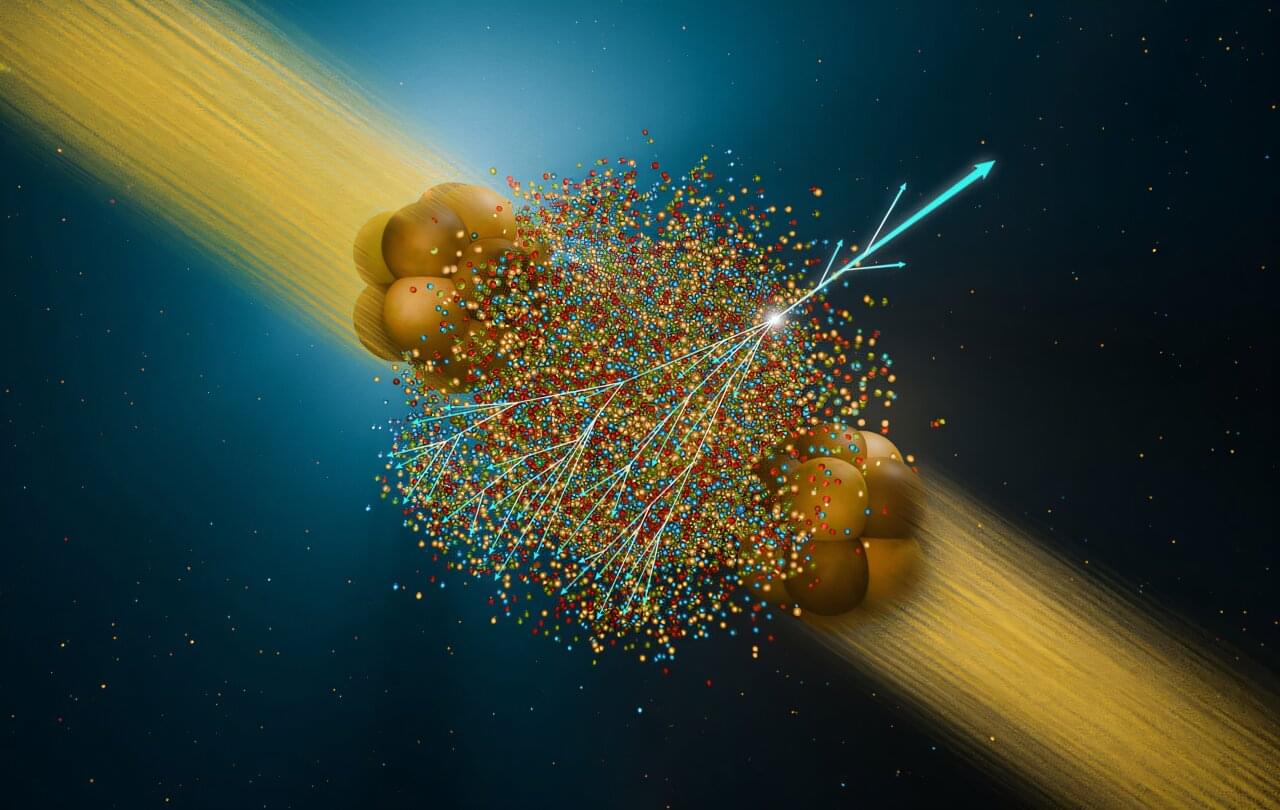
New results from the STAR experiment at the Relativistic Heavy Ion Collider (RHIC) provide strong evidence that smashing oxygen nuclei together at nearly the speed of light generates a quark-gluon plasma (QGP), a type of matter that existed just after the birth of the universe. The data, just published in Physical Review Letters, show that energetic jets of particles lose energy as they traverse the hot, dense matter left in the collision’s wake.
This energy loss phenomenon, known as jet quenching, has been one of the “smoking gun” signatures of QGP formation in collisions of larger atomic nuclei at RHIC, a U.S. Department of Energy (DOE) Office of Science user facility that operated at DOE’s Brookhaven National Laboratory from 2000 until earlier this year. This signature has also been observed in oxygen–oxygen collisions at the Large Hadron Collider (LHC), located at CERN, the European Particle Physics Laboratory. The analysis from RHIC at significantly lower collision energy sets a new lower boundary for the conditions capable of producing the primordial QGP in this small collision system.
“The QGP is believed to be the form of matter that filled the early universe—before the protons and neutrons that make up today’s atoms formed. Understanding its properties is essential for uncovering how the early universe evolved in its first microseconds,” said Li Yi, a professor of physics at Shandong University who oversaw the STAR analysis. “One of the most powerful ways scientists study the QGP is by identifying where its signatures appear—and just as importantly, where these signatures turn off,” she said.