I read the BindCraft paper: super cool approach for using AI to design de novo protein binders with a high success rate! While RFD4 Proteina seems to have recently outdone BindCraft in a lot of ways, this was still a very interesting and educational read.
Computational protein design offers a powerful alternative, enabling the tailoring of binders to specific targets and binding sites. Physics-based methods such as Rosetta allowed early binder design by means of scaffolding and side-chain optimization2,3. However, such methods suffer from low experimental success rates (less than 0.1%) and require the sampling of many designs2,4. Moreover, they typically require the docking of predefined scaffolds onto a fixed target structure, leading to surface incompatibilities and suboptimal binding, or even precluding the targeting of certain sites.
Recent breakthroughs in deep learning have revolutionized the field of biomolecular modelling. Models such as AlphaFold2 (AF2)1 have demonstrated remarkable capabilities in accurately predicting protein structures and complex PPIs. Indeed, AF2 filtering has been shown to increase the success rates of binder design by evaluating the plausibility of predicted complexes4,5. Deep learning has also been successfully applied for de novo design of proteins and binders. The current state-of-the-art methods involve the use of RFdiffusion5 for backbone generation coupled with ProteinMPNN sequence generation6. When applied to binder design, this approach shows significantly improved success rates compared with previous methods5. However, RFdiffusion relies on sequence design over side-chain-free backbones placed at a rigid target interface, with binder selection ultimately depending on AF2-based complex prediction to identify plausible interactions. This highlights a gap between backbone generation and functional interface design that AF2 filtering helps to bridge.
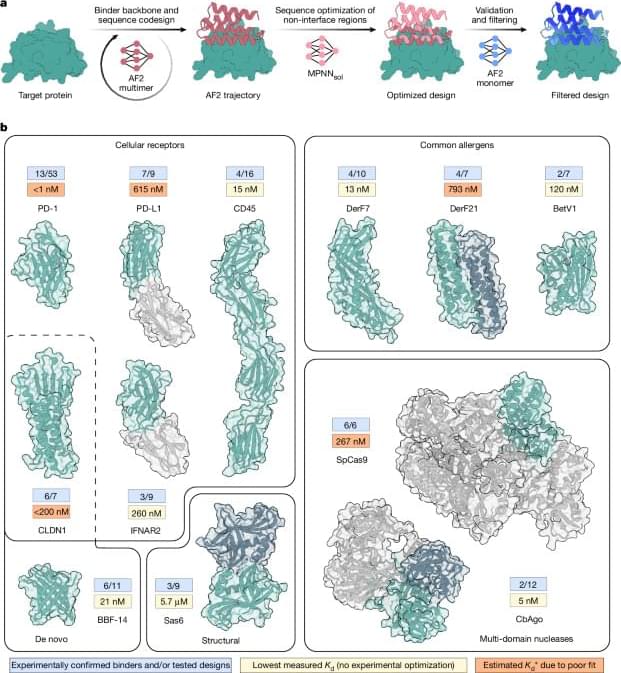
Given the use of AF2 in improving binder filtering success, we proposed that we could harness it directly for the design of protein binders. We present BindCraft, a user-friendly pipeline for de novo design of protein binders that requires minimal user intervention and computational expertise. BindCraft leverages backpropagation through the AF2 network to efficiently hallucinate new binders and interfaces (Fig. 1a). We demonstrate the efficiency of our pipeline on 12 diverse, challenging and therapeutically relevant protein targets (Fig. 1b). We identify several high-affinity binders for each target without the need for high-throughput screening of hundreds to thousands of designs experimentally. This marks an important advancement in the design of protein binders on demand, and makes binder design accessible to research groups without expertise in computational design methods or access to high-throughput screening facilities.