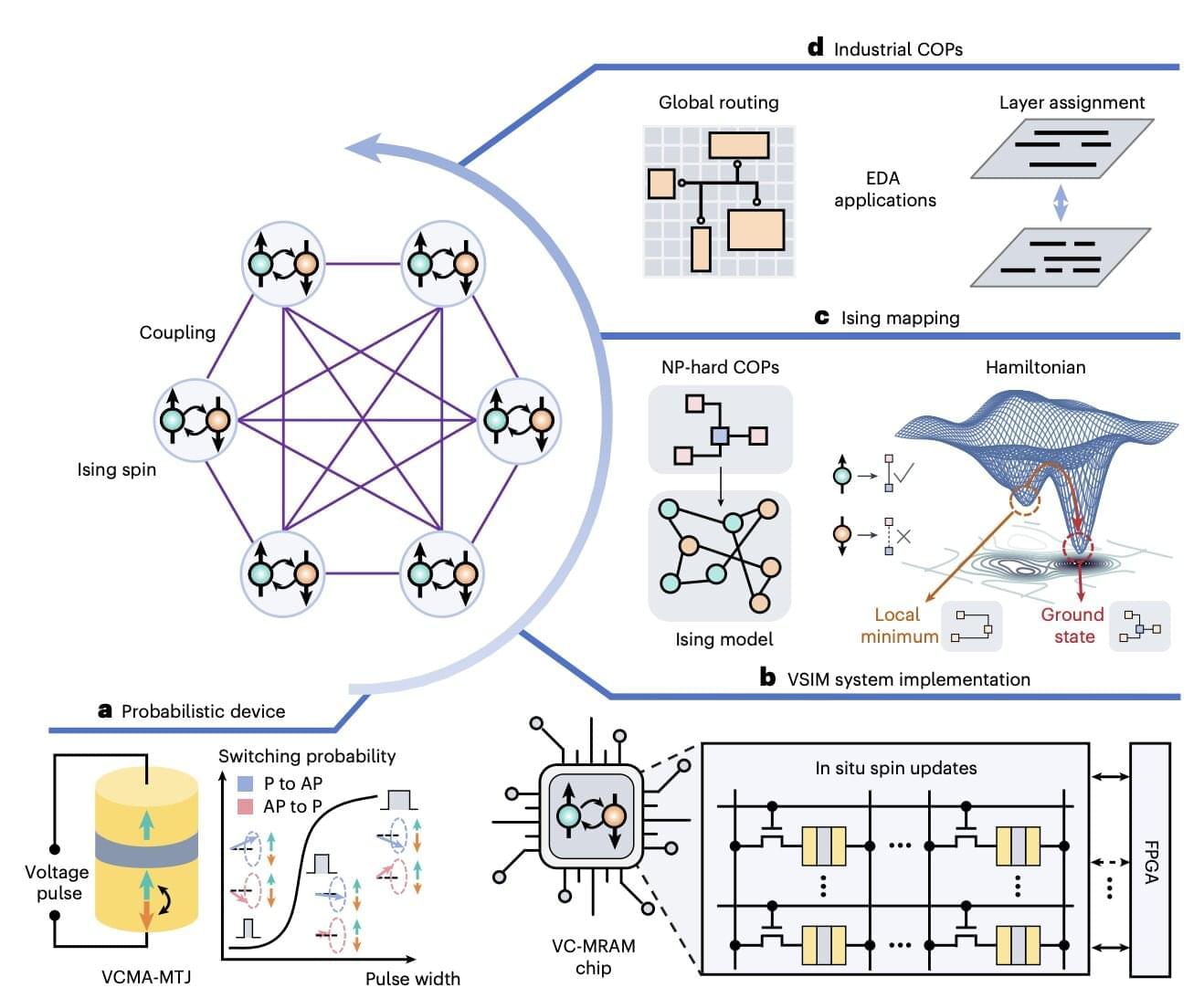
When designing new computer chips, engineers need to make various decisions about how to connect their underlying components while efficiently using limited space. Planning these connections involves combinatorial optimization, or, in other words, a search for the best combination of choices under specific rules.
Ising machines, computing systems inspired by a mathematical model describing interacting magnets, could be promising for solving combinatorial optimization tasks. These systems represent choices using spins, which in this context are variables that can have one of two values. By changing these values, Ising machines can search for the best combination of options for solving specific problems.
Researchers at Beihang University, Suzhou Inston Technology Co. Ltd. and Empyrean Technology Co. Ltd. recently developed a new Ising machine based on spintronics, technologies that use the magnetic properties of materials to process or store information. The new machine, introduced in a paper published in Nature Electronics, could solve complex combinatorial optimization tasks, including planning wiring routes and assigning connections to different wiring layers in computer chips.