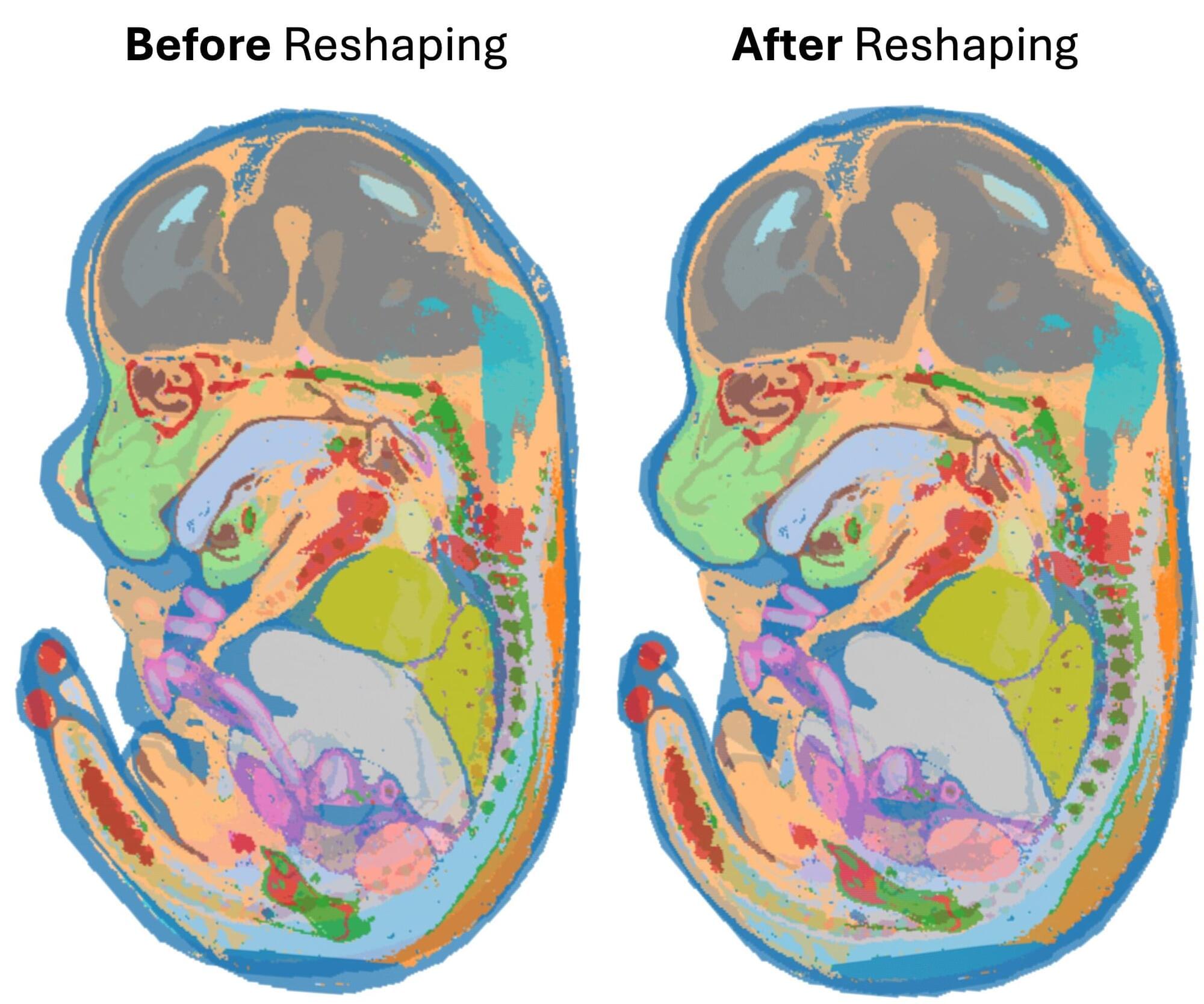
Spatial transcriptomics can reveal where thousands of genes are active across a tissue, creating molecular maps at single-cell resolution. But comparing two such maps is difficult: thin slices of tissue may be rotated, stretched or otherwise distorted, so equivalent regions do not automatically line up.
Researchers at Kanazawa University and Sapienza University of Rome have developed a computational method that aligns these maps directly from the individual measurement locations and their gene-activity values. Called Domain Elastic Transform (DET), it smoothly reshapes one digital map to match another without first converting the measurements into a regular grid of pixels.
The research, led by Osamu Hirose of Kanazawa University in collaboration with Emanuele Rodolà of Sapienza University of Rome, was published in IEEE Transactions on Pattern Analysis and Machine Intelligence.