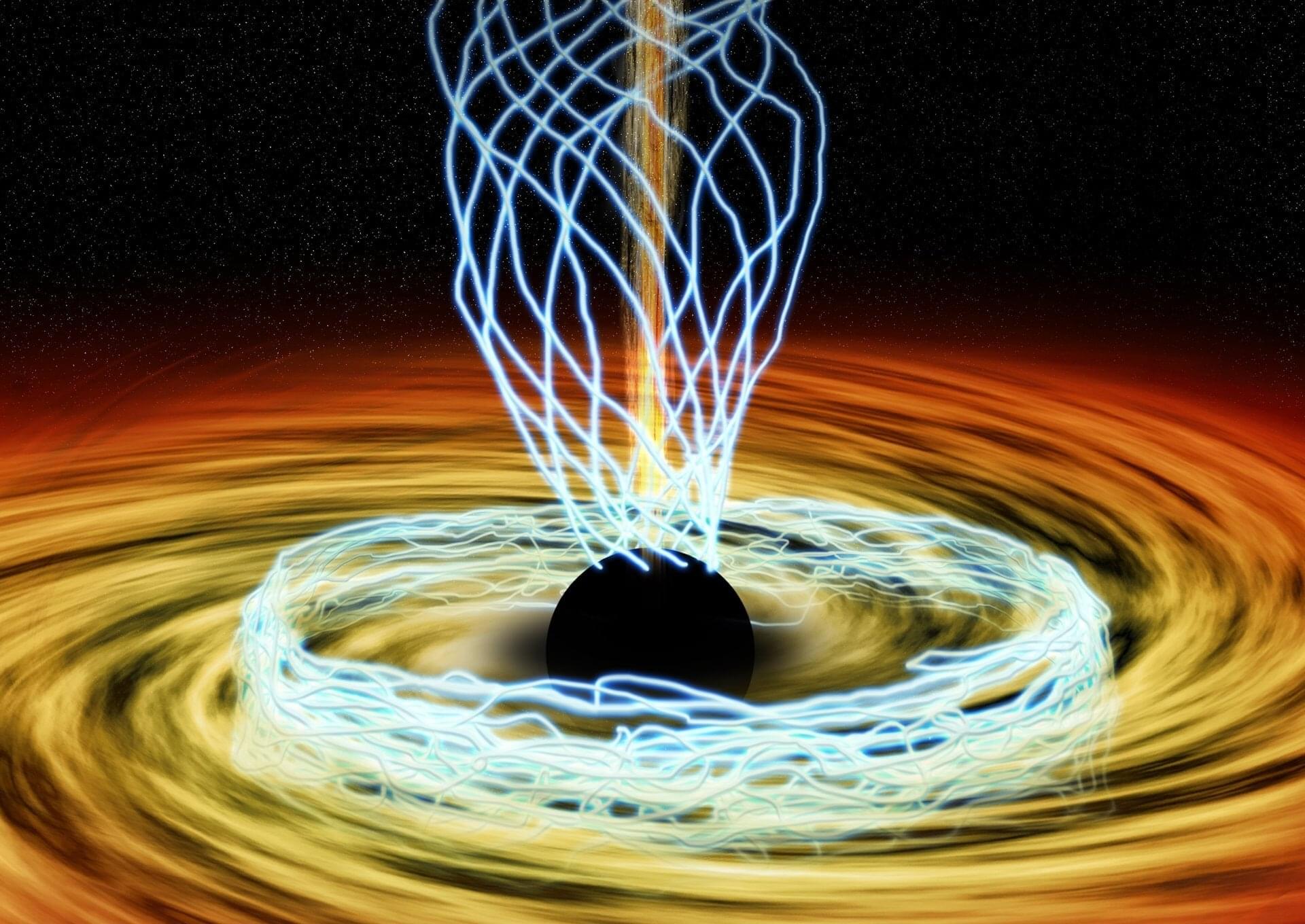
Galactic black holes are cosmic mitochondria, powerhouses of the universe. Most of the energy these supermassive black holes produce comes from the material surrounding them: superheated plasma in their accretion disks interacting with tremendous magnetic fields. But there is a more direct way to extract energy from a black hole. It’s known as the Penrose process, and a new study asks whether we could discover a signature of this process.
First proposed by Roger Penrose in 1969, the mechanism describes how you could extract energy directly from a rotating black hole, thus decreasing its total mass. This is different from the usual mechanism in which black holes generate power as a byproduct of consuming matter and increasing mass. It relies on a feature of rotating black holes known as the ergosphere.
As a black hole rotates, it drags space around it. This frame-dragging effect is most powerful very close to the black hole. The ergosphere is a region around the black hole where the frame dragging is so strong you can’t counter it. Even if you had a spaceship capable of approaching the speed of light, you couldn’t overcome the rotating frame. You will rotate around the black hole no matter what. Because of this, the timey-wimey effects of relativity get a little mucky-wucky.