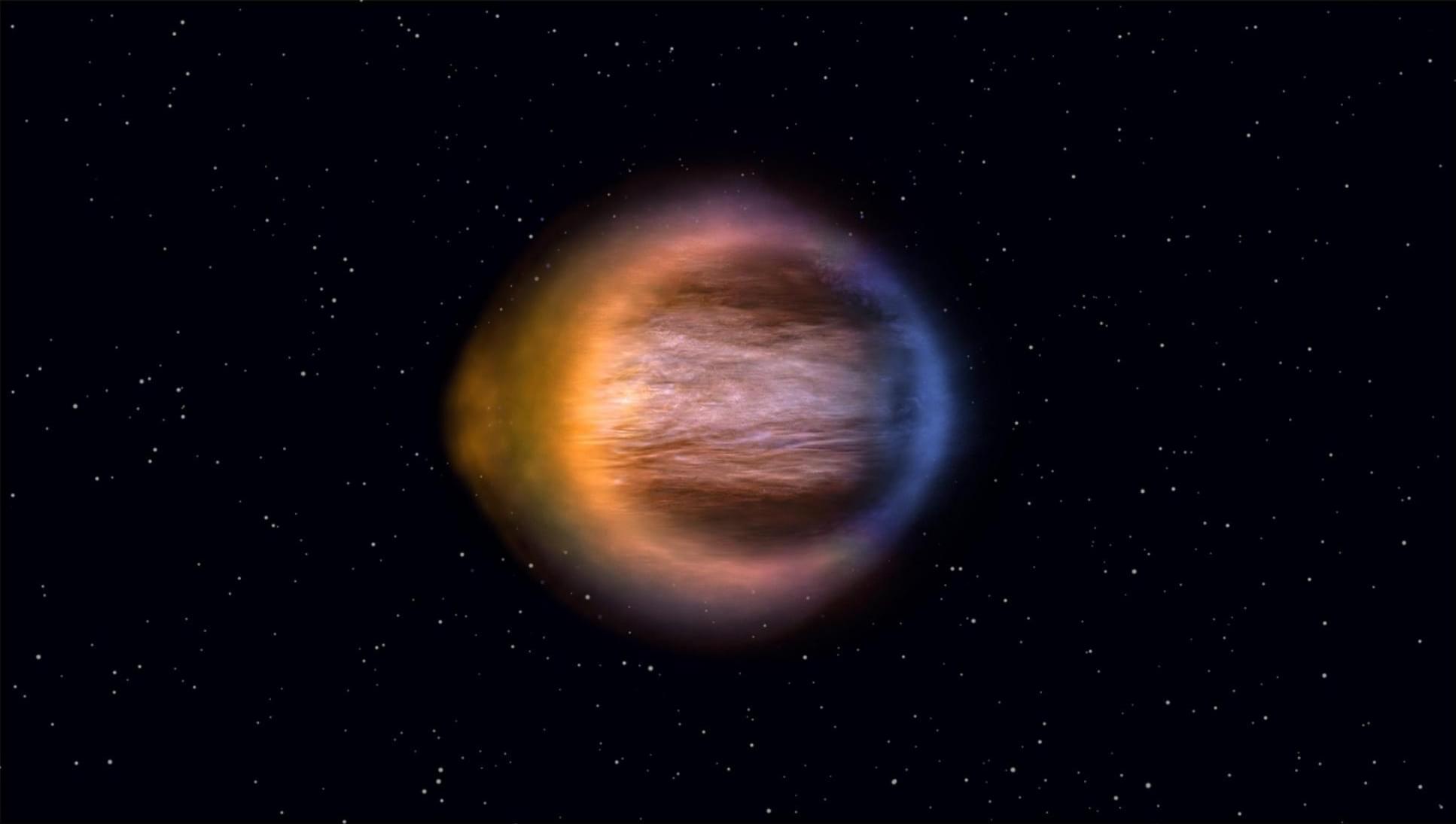
Weather maps of distant planets are a step closer after the James Webb Space Telescope distinguished hotter and cooler regions around the giant exoplanet WASP-17b.
One side of WASP-17b’s atmosphere extends farther into space than the other, giving this intensely hot giant planet an uneven outline. Astronomers have now mapped that distortion with the James Webb Space Telescope (JWST), finding a pattern consistent with predictions of how heat and powerful winds shape a world with permanent day and night sides.
WASP-17b is a hot Jupiter, a giant planet that orbits close to its star, about 1,300 light-years from Earth. The study, co-led by Cornell University in the United States and the University of Bristol in the United Kingdom, was published in Nature Astronomy. It marks the first application of a method called transmission strings, developed at Bristol by astrophysicists Dr. David Grant and Dr. Hannah Wakeford.