An unexpected and potentially big finding:
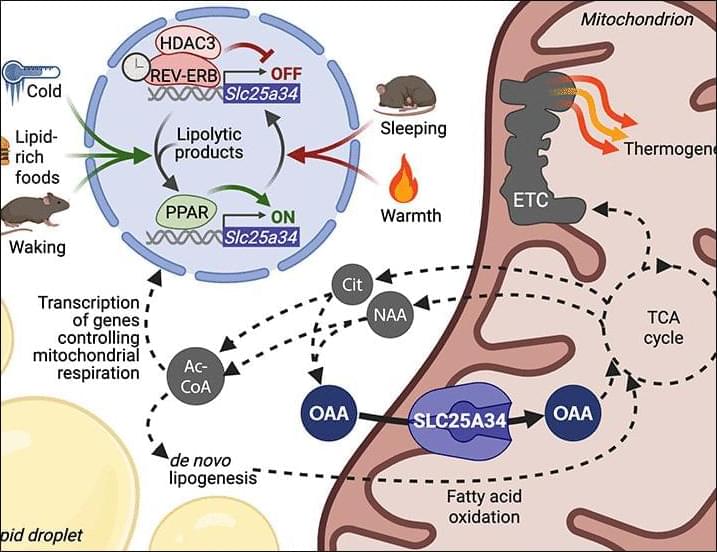
A single mitochondrial protein has an outsized role, acting as a central node, coordinating our circadian clock, temperature, dietary cues, sleep/wake cycle to control brown fat metabolism.
Brown/beige fat burns energy to keep the body warm and is linked to metabolic health. Its activity follows a daily rhythm (high when you’re awake, low during sleep), but it can also ramp up *suddenly* in response to cold weather or a fatty meal. How one system handles both scheduled and surprise demands was a mystery — until now.
The answer: one mitochondrial protein, SLC25A34.
The researchers found that three different signals — the circadian clock, diet, and temperature — all funnel through a single orphan mitochondrial transporter called SLC25A34.
How it works:
- During sleep: The circadian clock proteins REV-ERBα/β shut off SLC25A34 production.
- Upon waking: REV-ERB repression lifts, and PPAR proteins (PPARα/γ) switch SLC25A34 back on.
- Sudden demand (cold or a fatty meal): Lipolytic signals override the clock’s repression and boost SLC25A34 immediately — even at the “wrong” time of day. Once the energy need passes, normal circadian rhythm resumes.
Why SLC25A34 matters for fat metabolism.
SLC25A34 imports oxaloacetate into mitochondria. This does two things at once:
1. Keeps the TCA cycle running to power energy expenditure in thermogenic fat.
2. Supports production of cytosolic acetyl-CoA, which is needed to build new lipids — thermogenic fat continuously breaks down and resynthesizes lipids (“lipid cycling”), a self-reinforcing cycle.
Why it’s exciting.
A single mitochondrial carrier acts as the central hub integrating clock, temperature, and diet signals — an “outsized role” for one protein. The authors suggest SLC25A34 could be a new therapeutic target for boosting energy expenditure in metabolic diseases like obesity.
#sleep #Mitochondria #circadianrhythm #Thermogenesis #molecularbiology
Adipocyte lipid metabolism is coordinated by circadian rhythms, diet, and environmental temperature, but how these diverse signals are molecularly integrated remains unknown. We showed that these cues converge on the orphan mitochondrial transporter SLC25A34 to orchestrate lipid cycling. During the sleep phase, the adipocyte clock suppresses Slc25a34 expression through the REV-ERB transcriptional repressors. Entering the active phase, consuming lipid-rich diets, or exposure to cold abolishes REV-ERB repression, and lipolytic signals stimulate Slc25a34 transcription through the peroxisome proliferator–activated receptors. SLC25A34 is proposed to import oxaloacetate into mitochondria, dually supporting the tricarboxylic acid cycle and cytosolic acetyl–coenzyme A (acetyl-CoA) production.