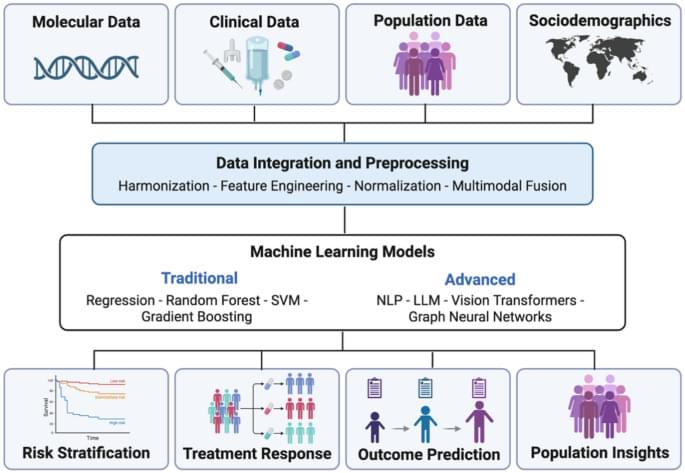
Outcome prediction in neuro-oncology remains challenging due to heterogeneity in tumor biology, imaging characteristics, treatment response, and patient-specific clinical factors. Although molecular databases have advanced understanding of brain tumor biology, many datasets lack broader data necessary for generalizable predictive modeling. Artificial intelligence (AI) and machine learning (ML) are increasingly being explored to integrate these heterogeneous data sources and support precision neuro-oncology.
A narrative review was performed using PubMed and Embase to identify studies evaluating oncology databases, ML models, multimodal data integration, and AI applications relevant to neuro-oncology. Studies published between 2020 and 2026 were preferentially reviewed, with additional landmark studies included when relevant.
Traditional ML approaches including regression-based models, random forests, support vector machines, and gradient boosting algorithms have been applied to survival prediction, recurrence classification, treatment response estimation, and molecular biomarker prediction using clinical, imaging, molecular, and population-level datasets. More advanced architectures including natural language processing, large language models, vision transformers, geometric deep learning, and graph neural networks have expanded the ability to analyze unstructured and multimodal data sources including radiology reports, histopathology slides, MRI volumes, molecular datasets, and electronic health records. Multimodal AI systems integrating imaging, molecular, histopathologic, clinical, and socioeconomic data frequently demonstrated improved predictive performance compared with single-modality models.