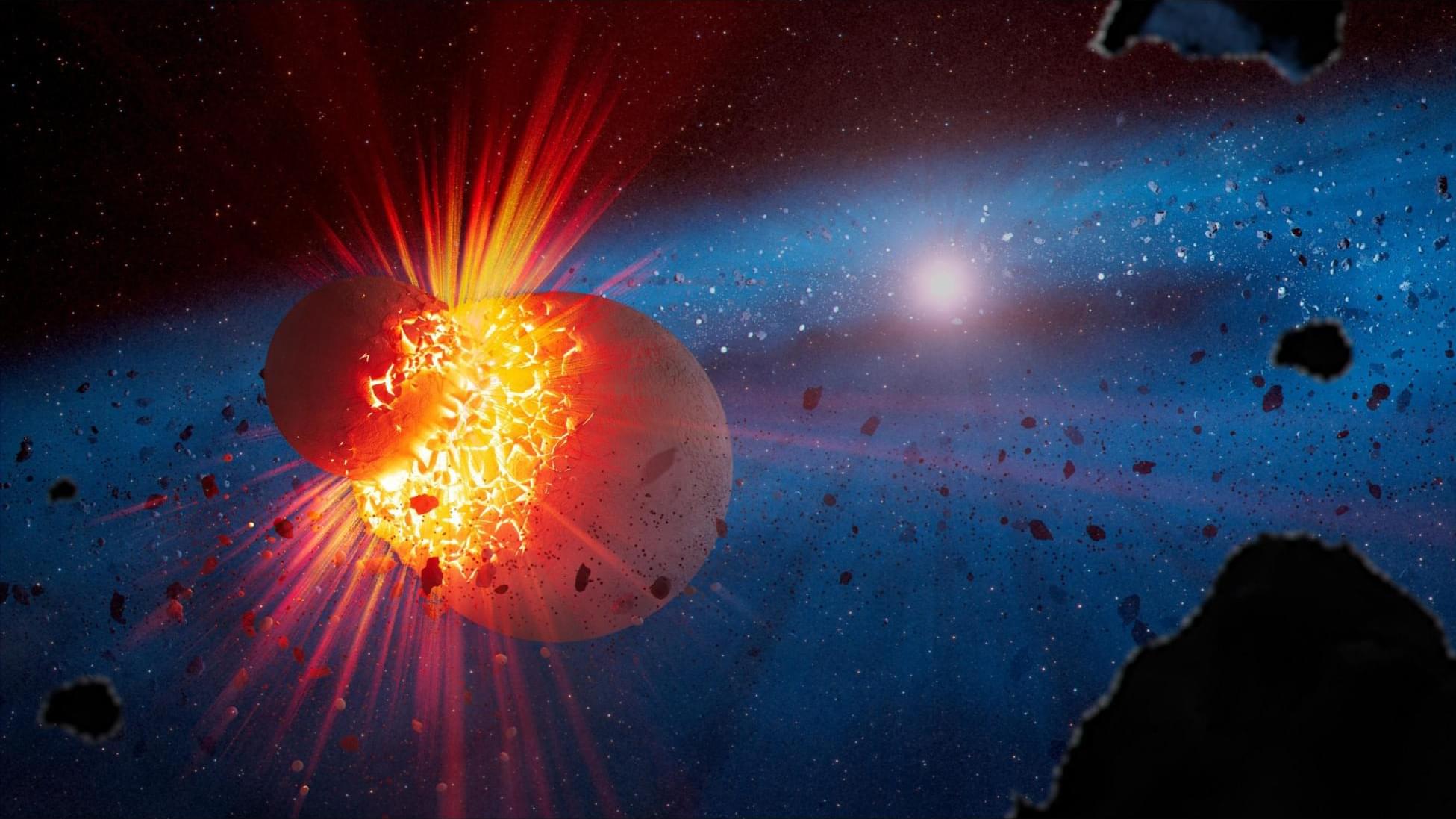
Dust around distant stars may reveal whether colliding worlds grazed one another or hit hard enough to vaporize rock.
Vaporizing vast amounts of solid rock, a Mars-sized world called Theia may have slammed into the infant Earth, blasting debris into space that eventually gathered into the Moon. Astronomers searching for similar collisions around distant stars cannot observe the developing planets directly because they appear too small at such great distances. They look for clues in the dust those impacts may leave behind, though these unusually dusty environments appear around only about 1% of young stars.
Kate Su of the Space Science Institute in Boulder, Colorado, and her colleagues used NASA’s James Webb Space Telescope to examine these environments, known as extreme debris disks. Using observations from Webb and NASA’s retired Spitzer Space Telescope, the team identified minerals through distinctive features in the dust’s mid-infrared light. Their findings, published in The Astrophysical Journal, suggest that those minerals could distinguish impacts powerful enough to vaporize rock from less energetic encounters.