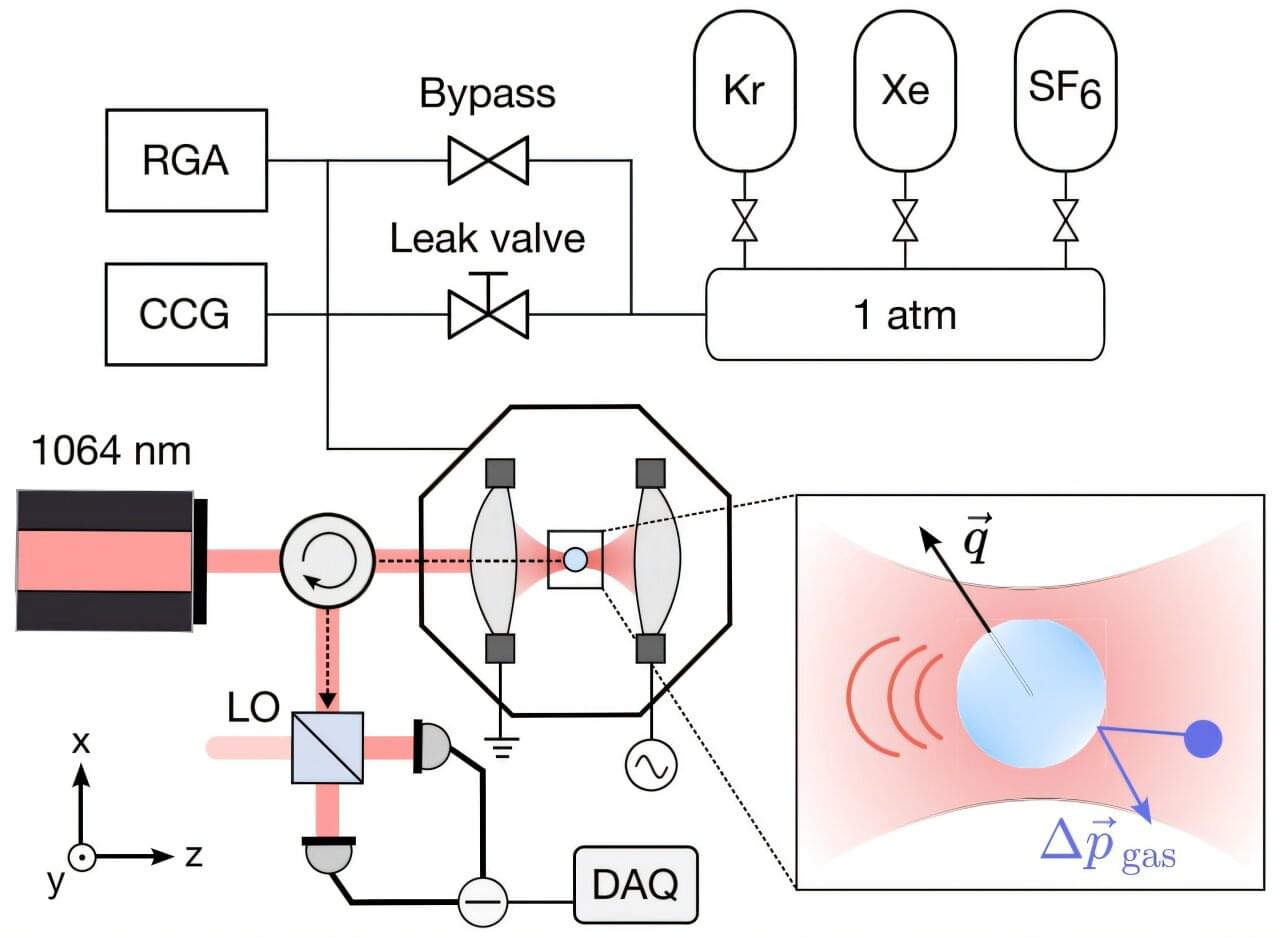
Tiny atoms and molecules are constantly bombarding each other all around us. While we regularly measure the large-scale effects of these interactions, measuring the effect of each individual collision is far more difficult. But now, researchers have managed to measure how tiny gas particles affect a single silica particle in the lab. In their new study, published in Physical Review Letters, the team describes how they detected the momentum transfers of individual collisions of gas particles with a nanoparticle levitated in laser light.
On a large scale, the billions of constant collisions in the air create what we experience as pressure. At higher altitudes, the particles are more spread out and the pressure is weaker than at sea level. The same thing happens in liquids, resulting in increasing pressures at increasing depths. Researchers have all kinds of tools (and multiple units) for measuring pressure.
In 1827, Robert Brown noticed that grains of pollen jiggled in water under a microscope. Later work by Einstein showed that this random movement of particles suspended in a fluid was caused by constant collisions with fast-moving atoms or molecules in the surrounding medium, now referred to as “Brownian motion.” Usually, the individual impacts are too small and frequent to distinguish without getting lost in background noise.