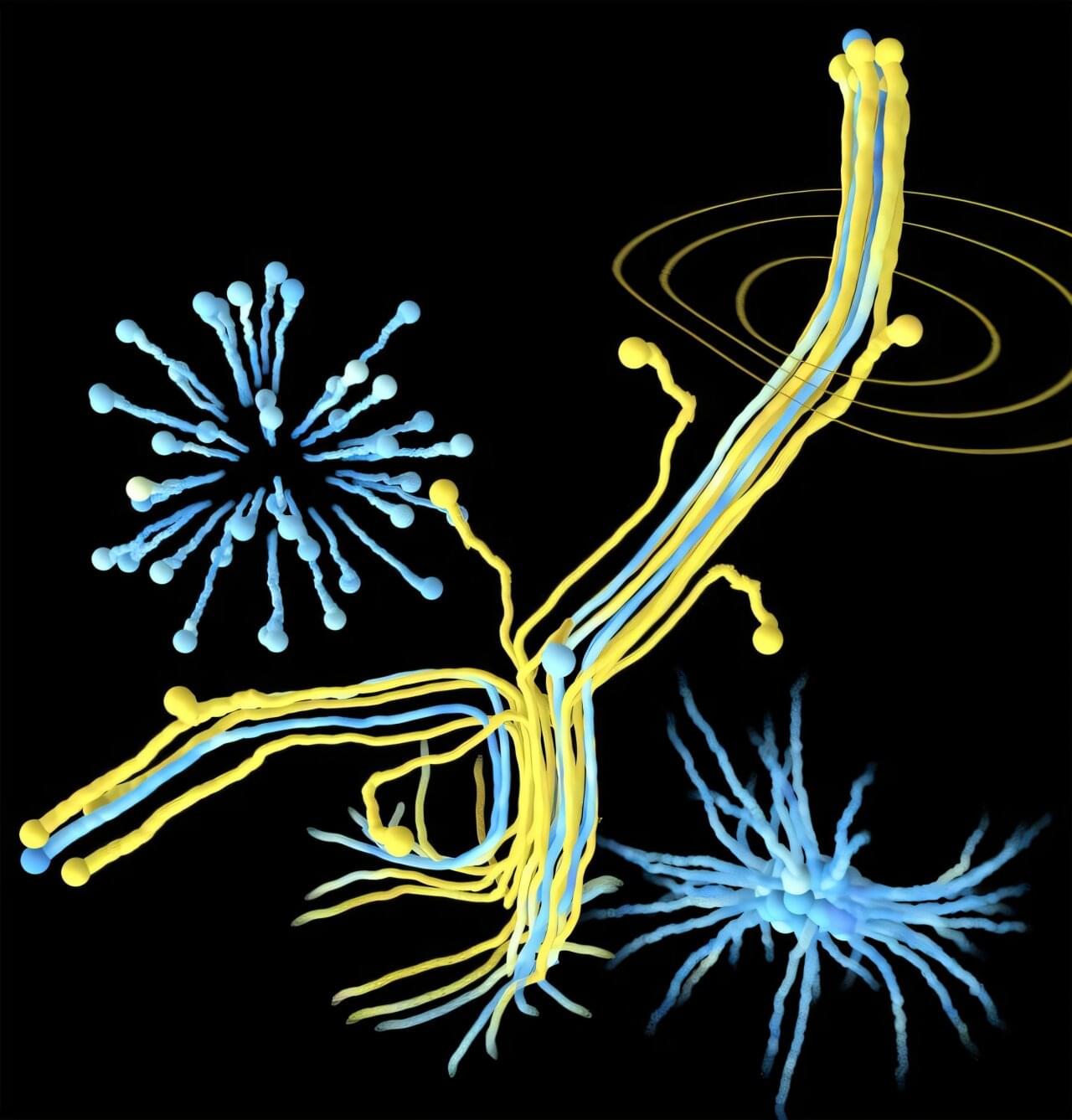
In nonreciprocal active matter, agents act differently on each other, seemingly in violation of Newton’s third law. This principle can result in various active matter traits, such as self-propulsion, molecular regulation and collective motion.
A new model describes how such nonreciprocal interactions can emerge spontaneously between chemically active vesicles. Physicists from the Department of Living Matter Physics at the Max Planck Institute for Dynamics and Self-Organization (MPI-DS) found that such vesicles can dynamically switch between ignoring, attracting, repelling and chasing each other.
The study is published in the journal Newton.