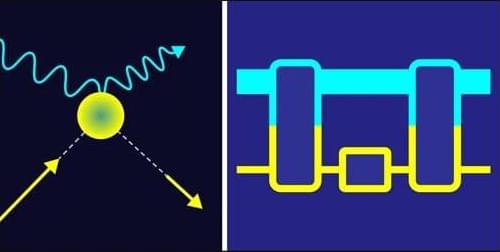
Pairing superconducting qubits with microwave cavities could reduce the hardware requirements for quantum simulations of fundamental physics.
Performing simulations of quantum systems on an ordinary computer is fundamentally difficult. The resources required to track the state of a quantum system grow exponentially with the size of the system. Therefore, even modest-sized simulations can exceed the capacity of the largest supercomputers. In 1982, Richard Feynman proposed using a controllable quantum system as the computer, so that the quantum mechanics of the machine itself performs the computation [1]. This proposal has grown into a worldwide effort to build quantum computers made up of large numbers of quantum bits, or qubits. But simulating fundamental physics poses a special challenge, as the two classes of particles—fermions and bosons—map to qubits in distinctly different ways.