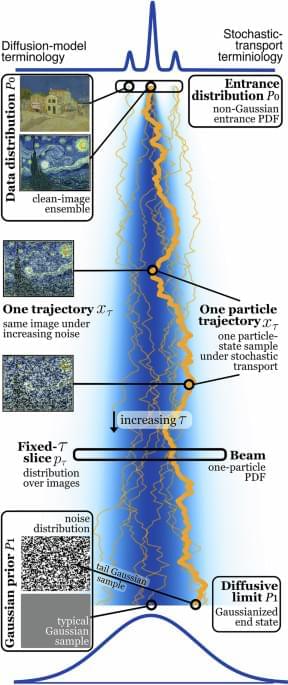
Image generators tune their noise by trial and error, because pictures have no clock. Turbulent plasmas do. By syncing an AI’s noise to the known rate at which particles spread, researchers built a surrogate that matches lab measurements—no tuning required.
The problem: Scientists often need fast, cheaper stand-ins (“surrogates”) for complex computer simulations of physical systems—in this case, systems where particles spread out over time, like heat diffusing or particles scattered by turbulence. A good stand-in should capture not just the average behavior but the full range of possible outcomes, including how spread out and lopsided the distribution becomes.
The tool they used: Generative diffusion models—the same kind of AI behind image generators—work by gradually adding noise to data and learning to reverse that process. But in image generation, there’s no physical meaning to “how much noise at each step”; the schedule is just a tuning choice. In particle transport, though, physicists already know how fast the spread (variance) grows over time, even without knowing the full distribution.
The key idea: The researchers set the noise schedule to match the known rate of spreading. This turns the model’s internal “time” into a real physical clock. The model then learns only the finer details—how the shape of the distribution evolves—without needing actual simulation data at intermediate times.
The result: Tested on particles moving through turbulent plasmas (going from fast, straight-line motion to slow diffusion), the surrogate reproduced the simulated particle distributions, matched the spread measured in the lab, and captured how the distribution’s shape (its “kurtosis,” or tailedness) evolved—all without any hand-tuning. This makes it useful both for fast emulation and for statistical inference from data.
#ArtificialIntelligence #PlasmaPhysics #turbulence #DiffusionModels
Stochastic transport often can be described using known laws for the variance evolution without knowing the distributional structure. Here, authors show how this knowledge informs the diffusion-model noise schedules so that the distributional structure can be learned only from the initial distributional data.