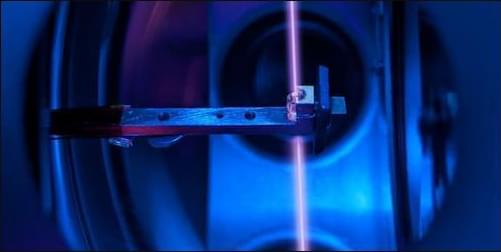
Clocks have always been about more than keeping time. In the 18th century, marine chronometers helped solve the “longitude problem,” enabling sailors to determine their ships’ east–west position at sea [1]. A new generation of ultraprecise clocks may now help researchers navigate uncharted territory beyond the standard model of particle physics. Building on decades of development, two independent teams—one led by Thorsten Schumm of the Vienna University of Technology and Ekkehard Peik of PTB, the German National Metrology Institute [2] and the other by Shiqian Ding of Tsinghua University in China [3]—have reported in Nature the first operating nuclear clocks. Their ticks are set by a transition in the atomic nucleus rather than by transitions of the electrons surrounding it.
Peik says he was “absolutely delighted” by the rapid progress and surprised by the clock’s robustness. Ding says he felt humbled to see decades of work come together in an operating clock. “Two years earlier, that still felt almost too ambitious to imagine,” he says.
These clocks don’t yet match the stability of today’s best atomic clocks, but they hold promise for both practical applications and tests of fundamental physics. Nuclear clocks could eventually become compact and robust, doing away with the ultrahigh-vacuum chambers and elaborate laser-cooling and trapping systems required by today’s most precise atomic clocks.