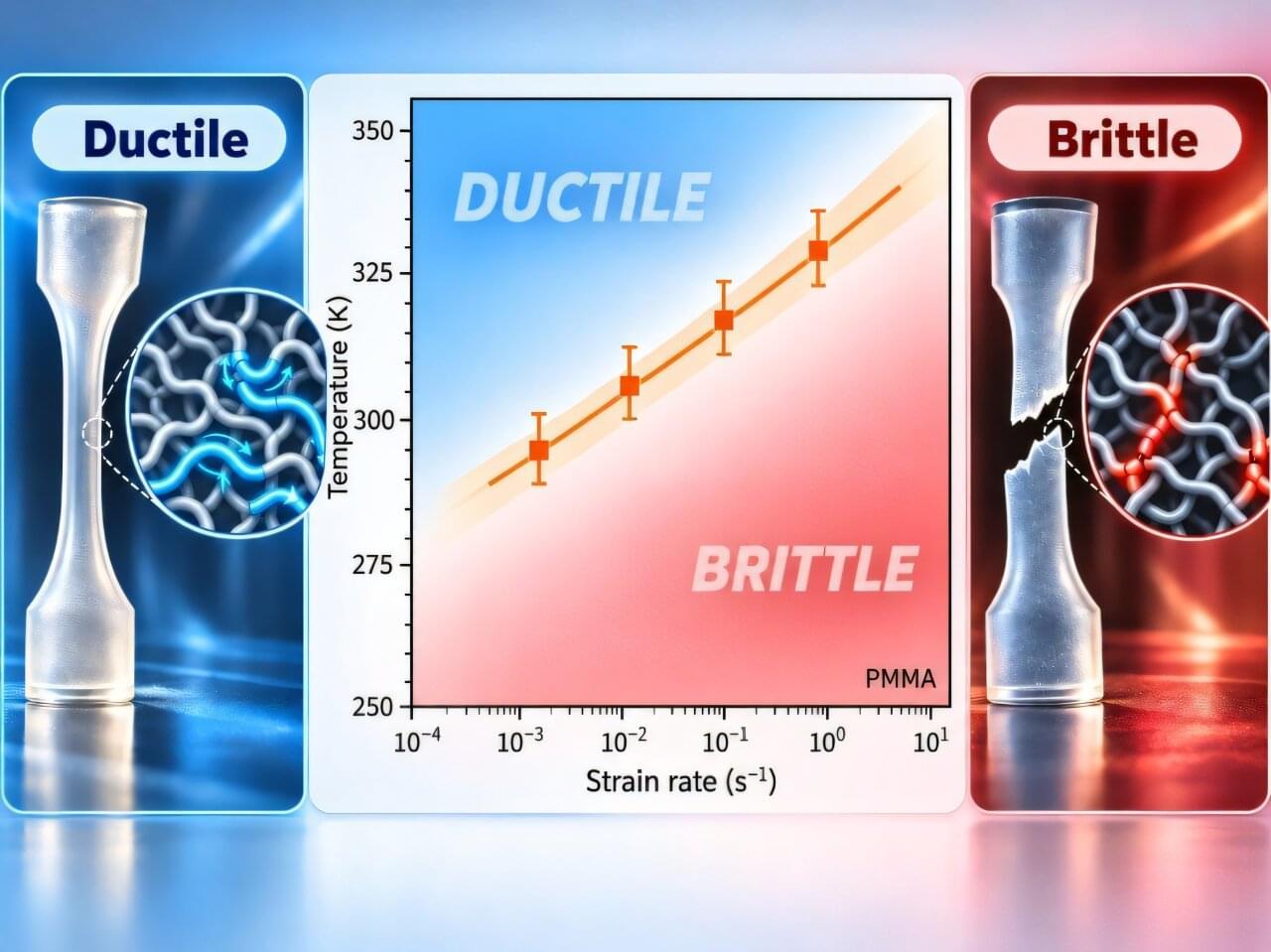
Glasses are (mostly) brittle, metals can be ductile (plastic), and liquids flow easily. Polymers are interesting because they exhibit all three types of behavior, depending on their chemical nature, temperature, and deformation rate. If polymers are not able to crystallize, their low-temperature state is glassy, and they are hard and transparent. One example is poly(methylmethacrylate) [PMMA], which has been used as an artificial glass since the early 20th century.
Surprisingly, polymer glasses can be ductile at temperatures significantly below their glass transition temperature, Tg. For a typical laboratory strain rate (~10⁻³ s⁻¹), the brittle-ductile transition temperature (BDT or TBD) can be 50–100 K below Tg. This result is surprising—naively, one would expect a “glass” to be brittle—yet polymers can deform plastically well below Tg.