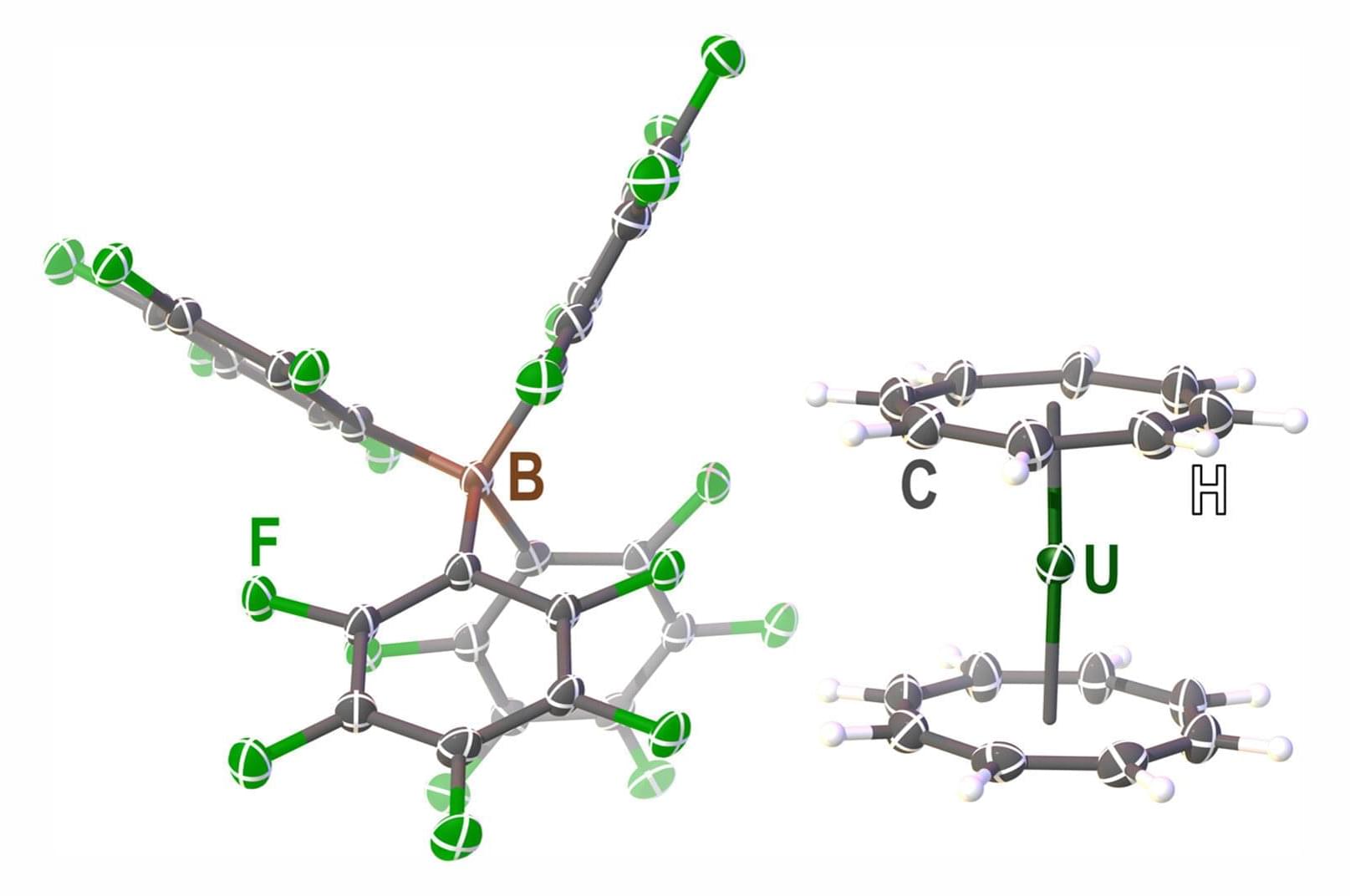
In a study published in Nature Communications, researchers from The University of Manchester and Lancaster University have isolated and characterized uranocenium, the positively charged form of a landmark uranium compound called uranocene. The work shows that this long-sought molecule is stable, and that it behaves in a way that challenges how chemists usually think about bonding in heavy elements.
Uranocene is a ‘sandwich’ molecule: a single uranium atom held between two flat rings, each made of eight carbon atoms. It is the uranium counterpart of ferrocene, an iron sandwich molecule whose discovery contributed to the 1973 Nobel Prize in Chemistry. Ferrocene readily gives up an electron to form the ferrocenium cation, a switch so clean and reliable that it is used as a reference standard in laboratories worldwide. Until now, no one had been able to isolate the equivalent uranium compound.