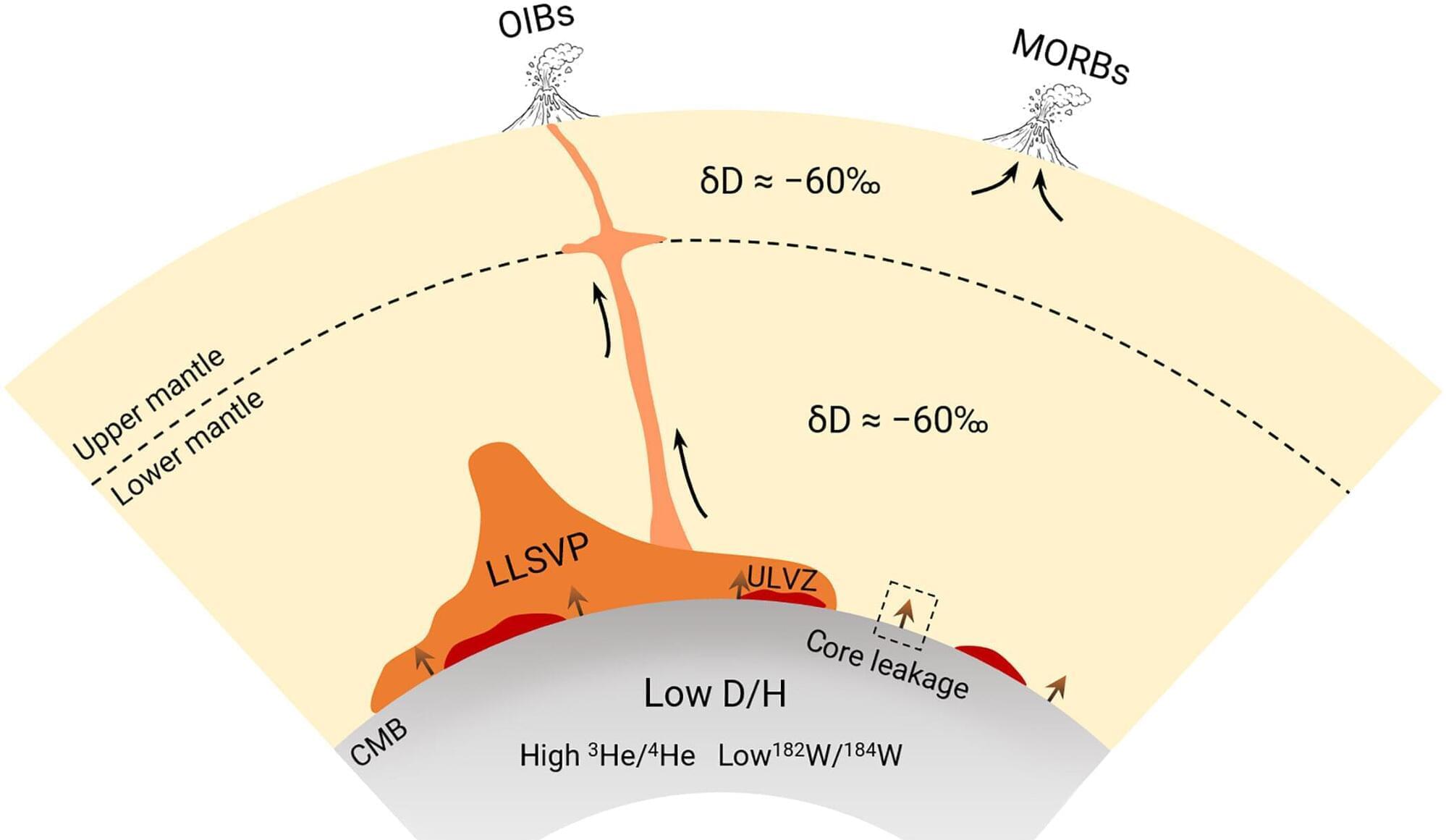
When Earth formed billions of years ago, its metallic core was wrapped in a global ocean of molten rock, which eventually cooled and crystallized to form the mantle. Today, when deep-rooted mantle plumes rise toward the surface and produce volcanic eruptions, the resulting lava can contain hydrogen from deep inside the planet.
Hydrogen comes in two stable forms, standard light hydrogen and a heavier version called deuterium. While most volcanic rocks have relatively normal hydrogen isotope ratios, some lavas associated with deep mantle plumes contain an unusually low proportion of deuterium.
That rare mix has provoked a major debate: Did this low-deuterium signature form long ago as the early magma ocean froze, or does it come from hydrogen leaking out of Earth’s metallic core?