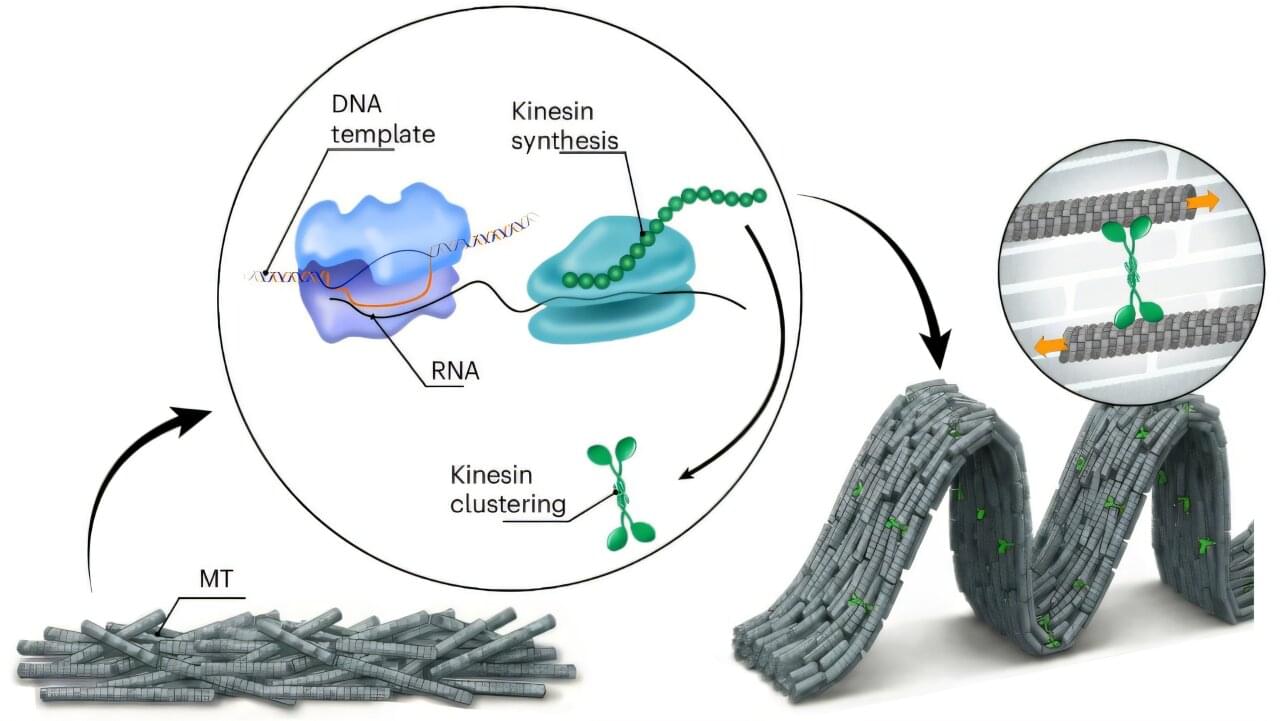
Researchers have created a material that manufactures the proteins responsible for cell movement, without needing intact living cells. By embedding cell-free gene expression into a thin sheet of protein filaments, they were able to make the material wrinkle, rise into blister-like shapes and break into bundles that flow around one another.
The instructions driving these transformations are built into the material itself—in DNA. Changing the genetic program made the filaments sustain flowing motion, stop after a burst of activity or repeatedly speed up and slow down.
The study, published in Nature Materials, demonstrates mechanical behavior that is “genetically programmed and executed autonomously,” as the authors describe it. Once assembled, the material can change its activity without researchers intervening at each step.