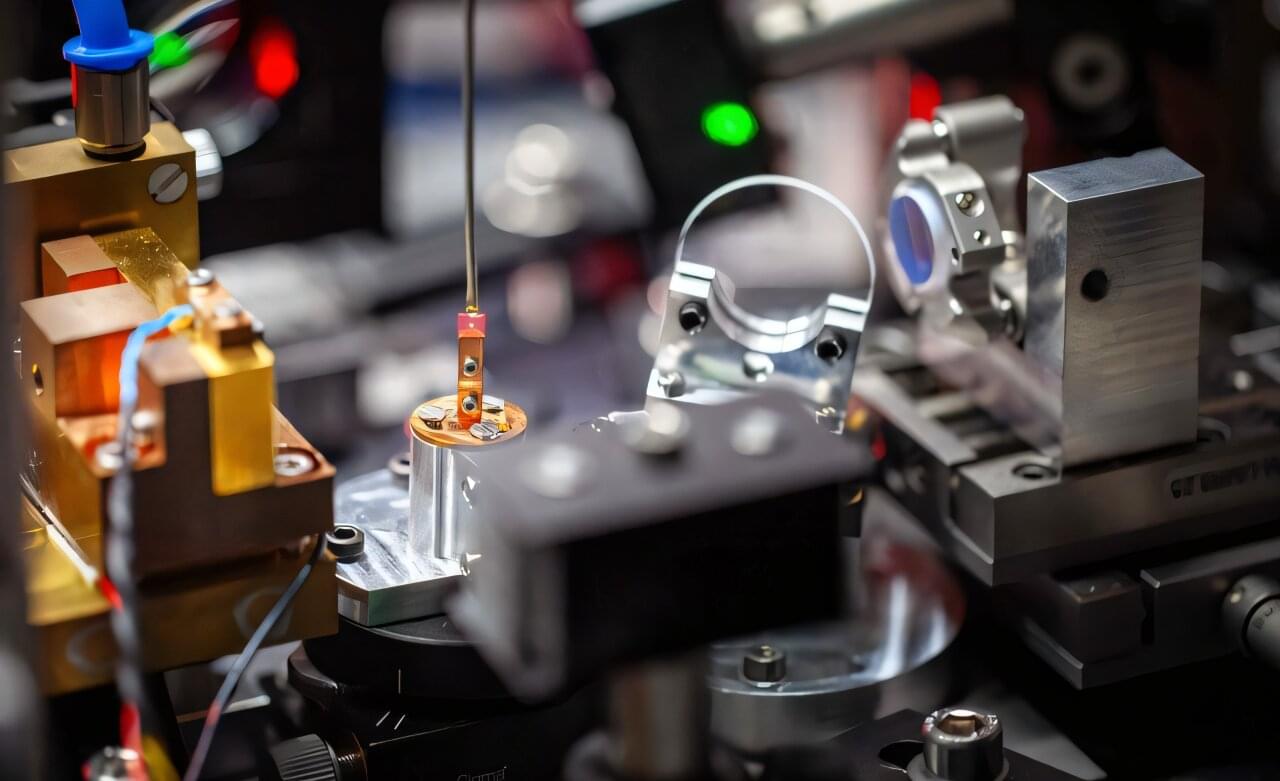
Researchers at Fraunhofer IAF have developed a laser-enhanced quantum sensor that combines high magnetic-field sensitivity with a large dynamic range. Using laser threshold magnetometry, they improved the ratio of sensitivity and dynamic range by a factor of up to 590 compared with state-of-the-art approaches. The breakthrough is enabled by the first demonstration of 100% optical contrast, combined with strong laser readout signals. The results, published in Nature Communications, open up new prospects for medical diagnostics, navigation, and resource exploration.
Magnetic-field sensors based on nitrogen-vacancy (NV) centers in diamond are among the leading solid-state quantum sensors. They operate at room temperature, can be integrated into compact devices and enable vector magnetometry—the measurement of both the magnitude and direction of a magnetic field. Recent advances have improved their sensitivity into the sub-pT/√Hz range, a regime relevant for detecting cardiac signals.
Until now, however, researchers have had to make a trade-off: sensors with very high sensitivity offer only a very limited dynamic range, while more robust variants with a large dynamic range were considerably less sensitive.