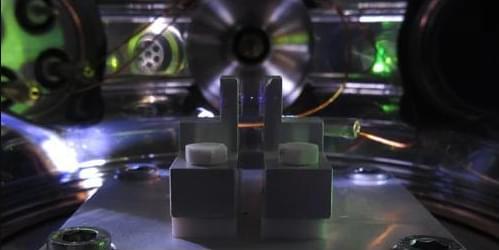
An experiment resolves the tiny momentum transferred from an individual gas molecule to a levitated nanoparticle.
For two centuries, collisions between atoms or molecules and small suspended objects have been understood only statistically. In 1827, Robert Brown first described the random motion of pollen in water. Eight decades later, Albert Einstein and Marian Smoluchowski independently explained the jitter as the accumulated effect of countless unseen molecular impacts—convincingly demonstrating the physical reality of atoms and molecules. However, individual kicks were never resolved. Only their collective consequence, Brownian motion, was ever visible. Modern trapped-ion experiments succeeded in watching individual atom–ion collisions perturb a single confined ion’s motion [1]. But there, the “projectile” and the “sensor” were both individual atomic-scale particles of comparable mass. Now David Moore at Yale University and his colleagues have extended single-collision detection to a very different regime [2].