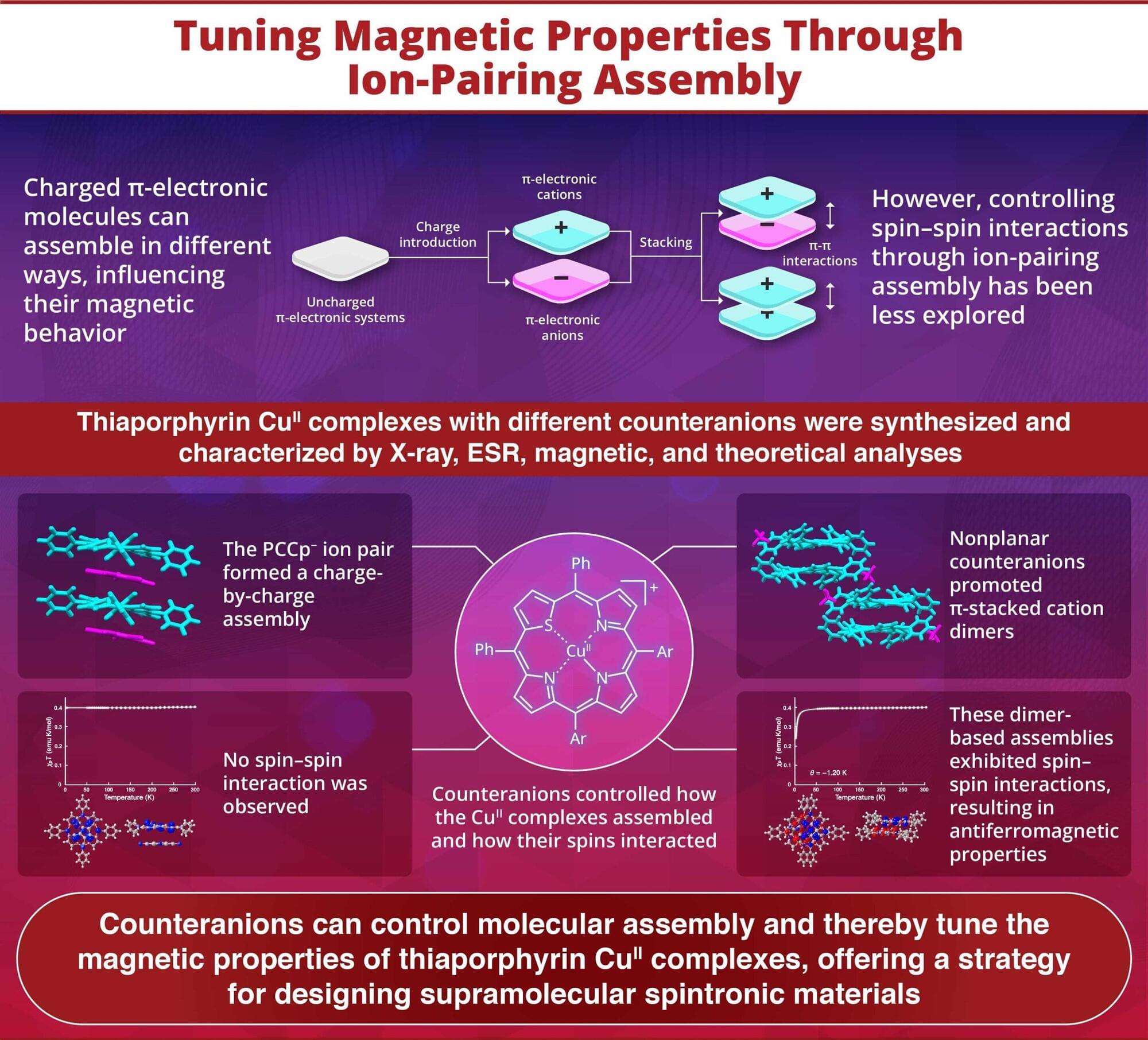
Magnetic properties in molecular materials depend not only on the molecular components themselves but also on their solid-state organization. In charged π-electronic systems, electrostatic and dispersion forces can organize molecules into distinct ion-pairing structures.
Oppositely charged species may form charge-by-charge assemblies, whereas like-charged π-electronic units can, under favorable intermolecular interactions, overcome electrostatic repulsion and form stacked dimers. Because intermolecular spin–spin interactions are sensitive to the proximity and relative orientation of paramagnetic units, controlling the assembly pattern provides a route to modulating magnetic behavior.
Yet solid-state intermolecular spin–spin interactions in CuII complexes of π-electronic macrocycles have been reported only in limited cases.