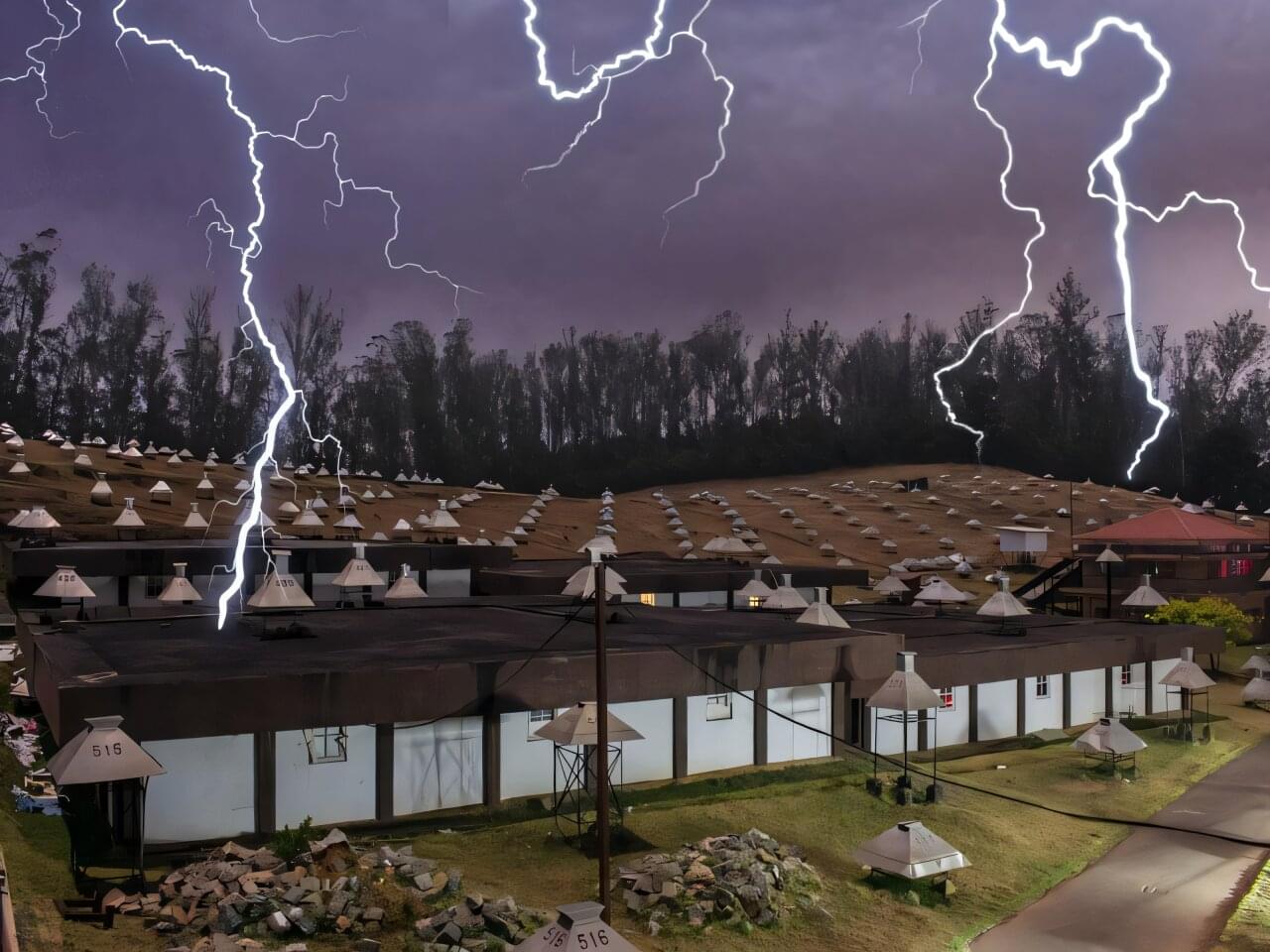
An instrument built to study cosmic rays has turned out to be a powerful tool for investigating thunderstorms. Earlier observations with the GRAPES-3 muon telescope revealed that thunderclouds can develop electrical potential differences far greater than those ever measured directly. But they also uncovered a puzzle: the instrument detected many more thunderstorm events in the eastern part of its field of view than in the western part. A new study by the same team, published in the Journal of Cosmology and Astroparticle Physics, has now explained why.
The asymmetry does not mean that thunderstorms are actually more common to the east. Instead, it arises from the way the geomagnetic field affects the cosmic rays traveling through Earth’s magnetosphere, making GRAPES-3 more sensitive to thunderstorms from some directions than others. The result strengthens the case for using these cosmic-ray particles as a natural probe of thunderstorm electricity.
Cosmic rays are a continuous flux of extremely high-energy particles arriving at Earth from outer space. Most primary cosmic rays are protons. Because they are electrically charged, their trajectories are deflected by Earth’s magnetic field. When they enter the atmosphere, they collide with atomic nuclei in the air, generating showers of secondary particles.