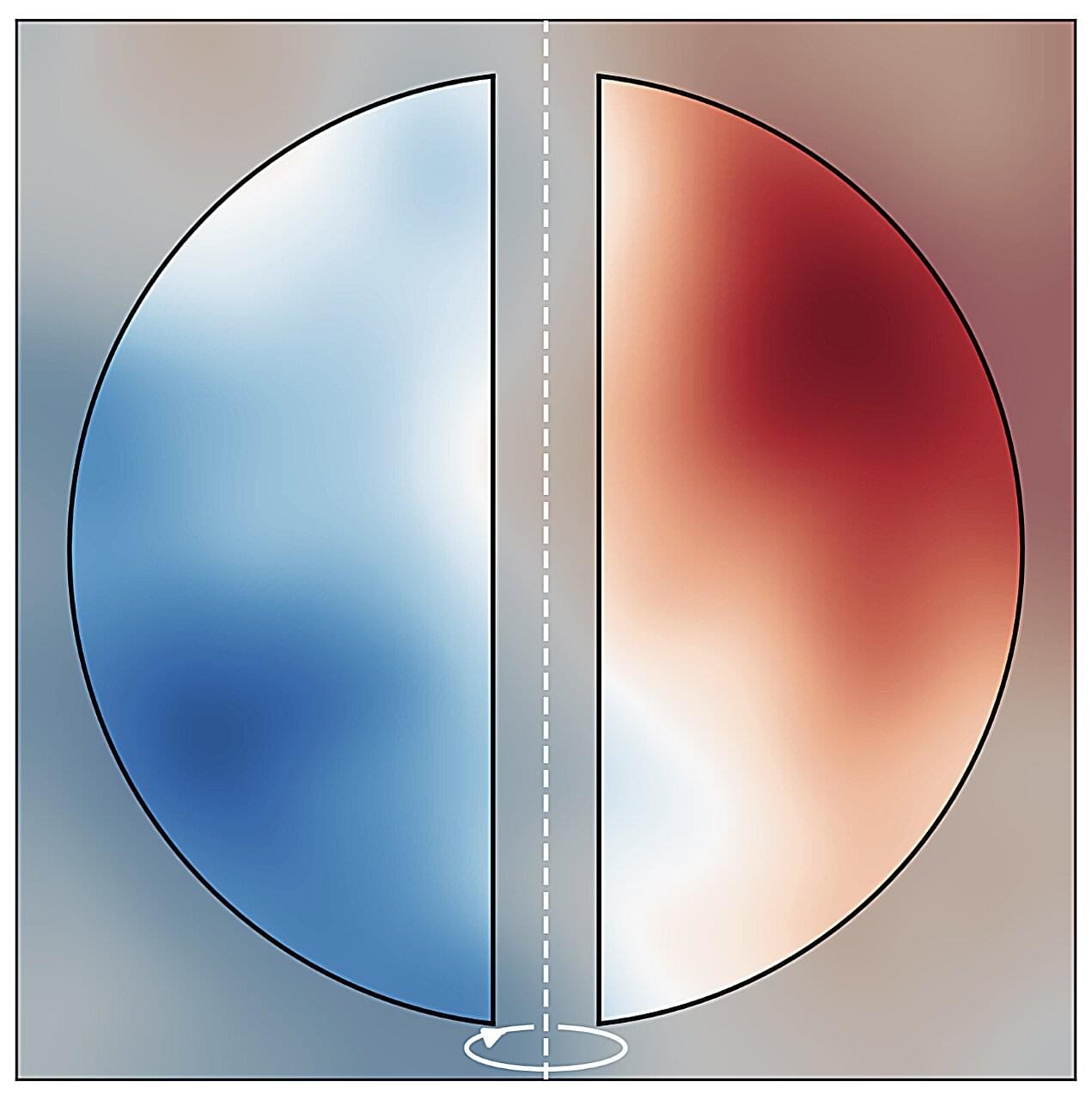
The cosmic microwave background (CMB) is a faint glow in the universe dating back to roughly 380,000 years after the Big Bang, long before stars or galaxies emerged. Detecting this light and mapping its fluctuations provide valuable insights into the age and composition of the universe.
Researchers at Columbia University recently analyzed CMB data and gathered evidence of a CMB signal that could be produced by internal gas motions in galaxy clusters, large collections of galaxies that are held together by gravity. Their findings, published in Physical Review Letters, strengthen earlier clues of this gas motion and a phenomenon called the rotational kinematic Sunyaev-Zel’dovich (rkSZ) effect reported by other astronomers.
“This project began after a meeting with my Ph.D. adviser, J. Colin Hill, in which we discussed signals in the CMB that hadn’t yet been observed,” Samuel Goldstein, first author of the paper, told Phys.org. “One of these is the rkSZ effect. As CMB photons pass through a galaxy cluster, they scatter off its ionized gas, and if the gas is rotating, one side of the cluster appears slightly hotter and the other slightly colder.”