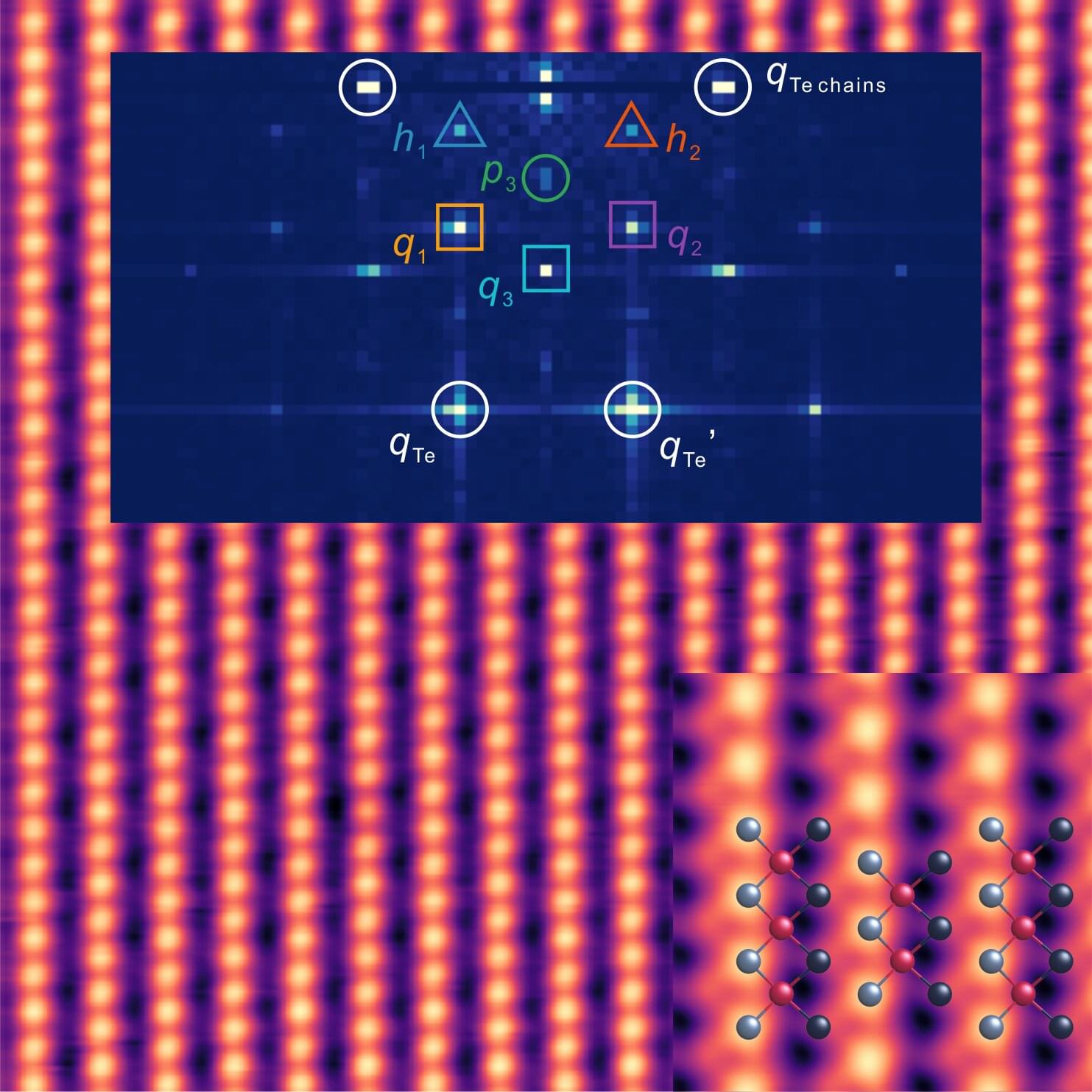
Physicists with the University of Illinois Urbana-Champaign’s Grainger College of Engineering have identified a new form of superconducting behavior. Experiments on the metal uranium ditelluride reveal that Cooper pairs, the composite electron units responsible for superconductivity, can organize into nonuniform patterns that exist even when the main superconducting phase is absent.
These patterns, known as pair density waves (PDWs), were first predicted 20 years ago and have been found to coincide with superconductivity in other metals. But new research published in the Proceedings of the National Academy of Sciences not only shows that PDWs exist in uranium ditelluride but also provides the first direct evidence that they can persist in the “ordinary” phase once superconductivity vanishes.
“Pair density waves are the Cheshire Cat’s grin of superconductivity,” said Eduardo Fradkin, an Illinois Grainger Engineering physics professor and a project co-lead. “They are the vestige that remains once the phase itself has disappeared. In conventional superconductors, Cooper pairs form when the full phase transition occurs, but in this system, their observation in PDWs above the transition point shows that they are formed beforehand in a different state.”