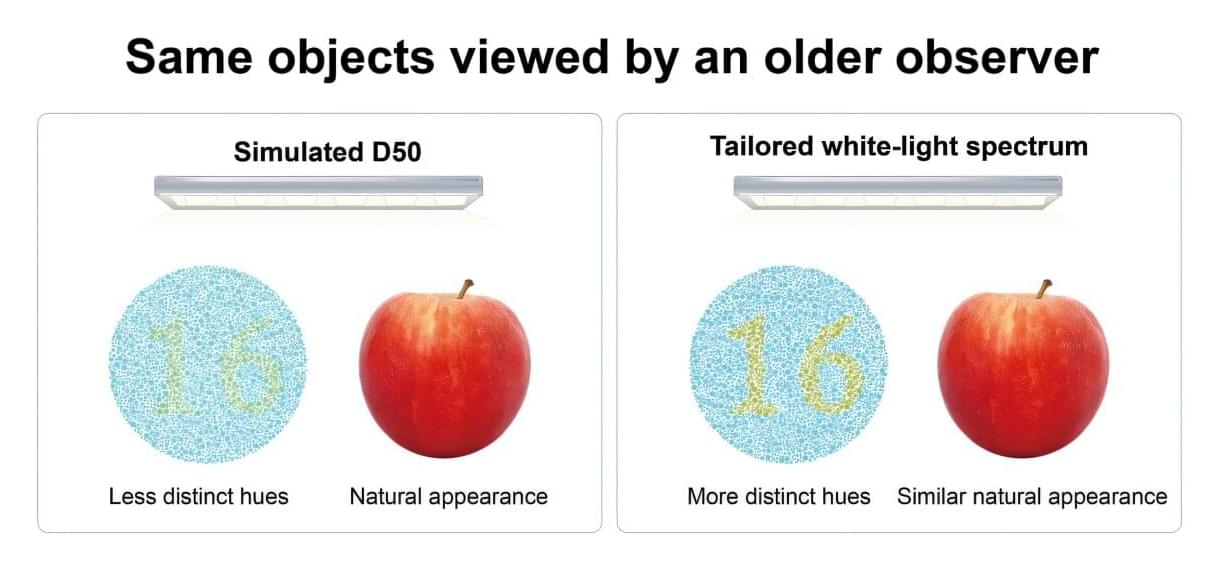
Researchers have developed a new computational model that accounts for the effects of aging on our eyes’ ability to discriminate color. It could help guide lighting designs that make it easier for older adults to perceive colors while preserving the expected appearance for people with typical color vision.
“As people age, the lens inside the eye gradually yellows and absorbs more short-wavelength light, which can make similar colors harder to discriminate,” said research team leader Qi Dai from Fudan University in China. “We incorporated these age-related changes into a model that can be used to guide the spectrum, or mixture of wavelengths, used for white lighting to make it easier for older adults to perceive colors.”
In the journal Optics Express, researchers from Fudan University and OPPLE Lighting report results from a study that used the new model to design lighting spectra that account for how aging eyes perceive color. In a group of adult volunteers ages 70 and older, the resulting lighting improved color discrimination compared with an LED-simulated D50 daylight reference at nearly the same color temperature, while familiar colors still looked natural.