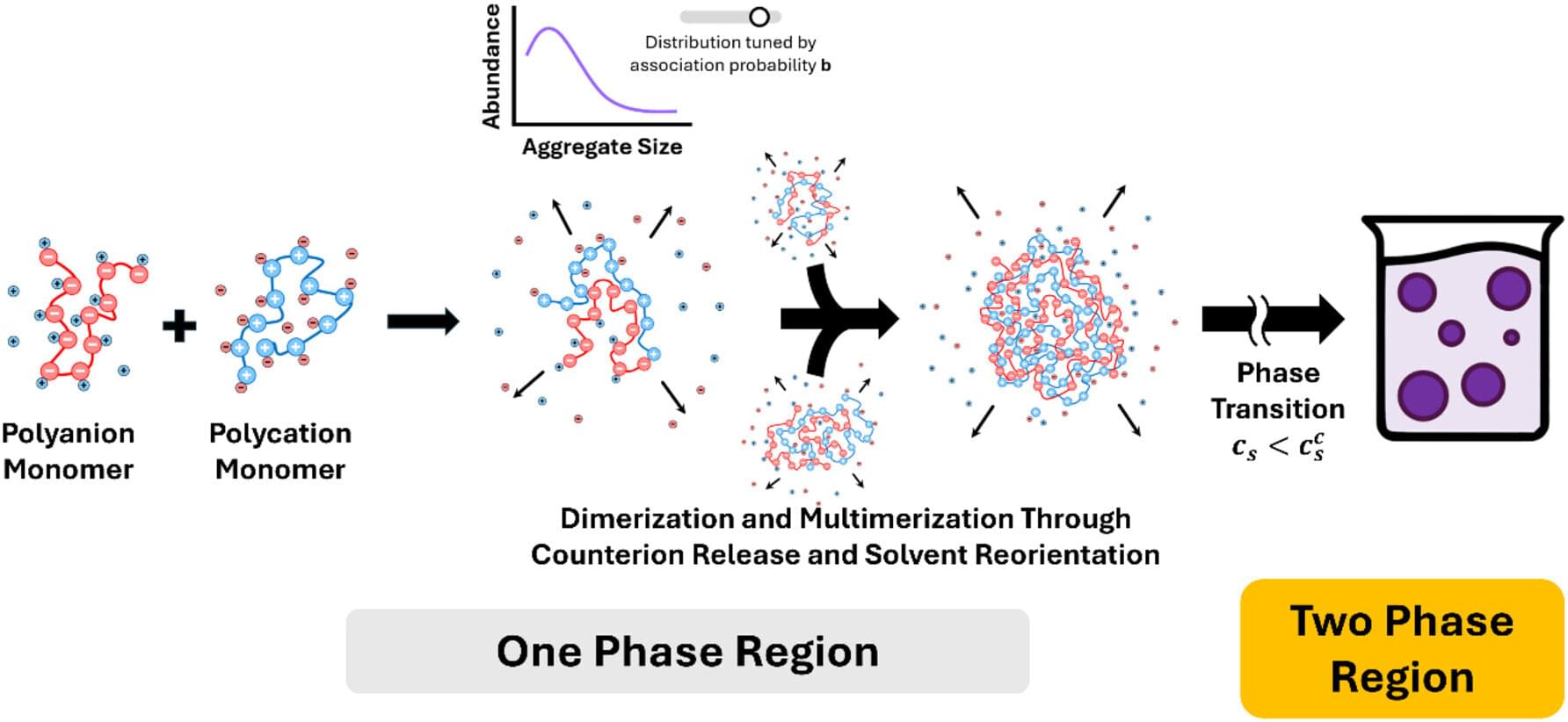
A polymer science revelation about how liquid mixtures separate could have major implications for human health, metabolism and disease, new research indicates. In a brief report published in the Proceedings of the National Academy of Sciences, University of Chicago Pritzker School of Molecular Engineering (UChicago PME) Professor Matthew Tirrell and Freie Universität Berlin Professor Matthias Ballauff revealed previously overlooked factors at play in the separation of charged polyelectrolyte polymers in water, challenging assumptions that have dominated the field since the 1950s.
Research into this liquid-liquid phase separation has been “given new urgency,” Tirrell said, by recent work highlighting the process’s role in creating biomolecular condensates. These membraneless cellular structures, straddling the gap between biomolecules and cells in both size and function, perform many tasks necessary for life.
“Biomolecular condensates play important roles in stress response, signal transduction, metabolism, gene regulation and many human diseases,” said Tirrell, director of UChicago PME’s Institute for Materials and Sustainability. “Understanding the mechanisms that help them form makes understanding phase separation as important to biology as it is to physics or chemistry.”