The density of DREADDs expression in the zona incerta compared to the LH is rather surprising considering this has not been consistently reported in the tracing literature. Maybe a few related comments could be added.
Reviewer 2:
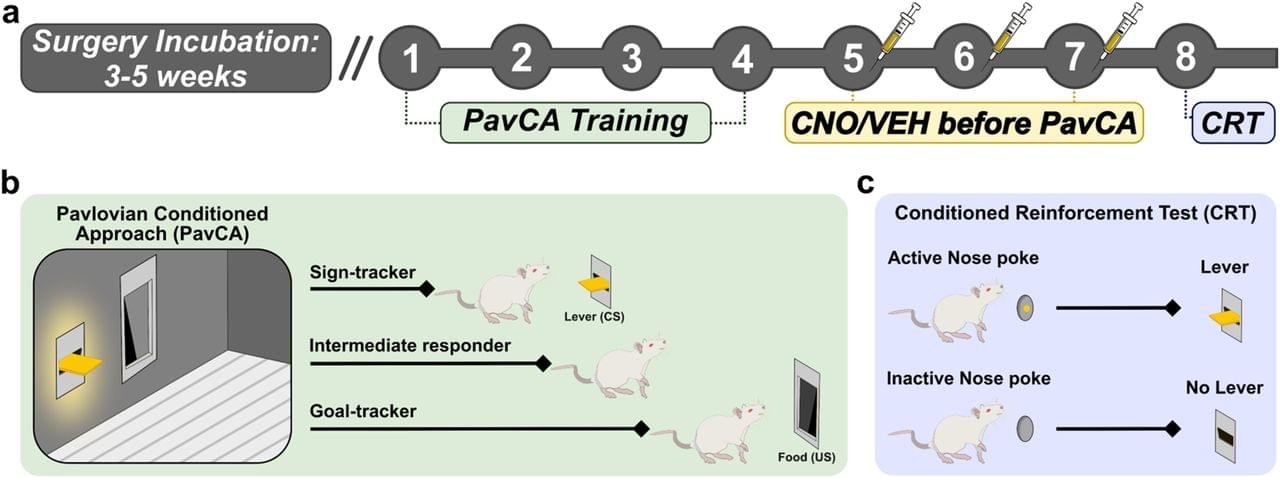
This study examines male rats for their responses to a Pavlovian conditioned approach paradigm, and the influence of the neuronal pathway from the lateral hypothalamus (LH) to the paraventricular nucleus of the thalamus (PVT) on these responses. From the Pavlovian conditioned approach paradigm, rats can be classified as sign-trackers (STs), goal-trackers (GTs), or intermediate responders (IRs), based on their level of approach and interaction with the cue compared to the location of reward delivery. With chemogenetic inhibition of the LH-PVT pathway, the authors find that goal-tracking but not sign-tracking can be attenuated, and that this primarily occurs in the IR population. In a control experiment, they find that injection of the DREADD actuator, CNO, does not significantly alter behavior. The authors conclude that the LH-PVT pathway is a selective contributor to reward-directed conditioned responding and a circuit substrate for behavioral flexibility.