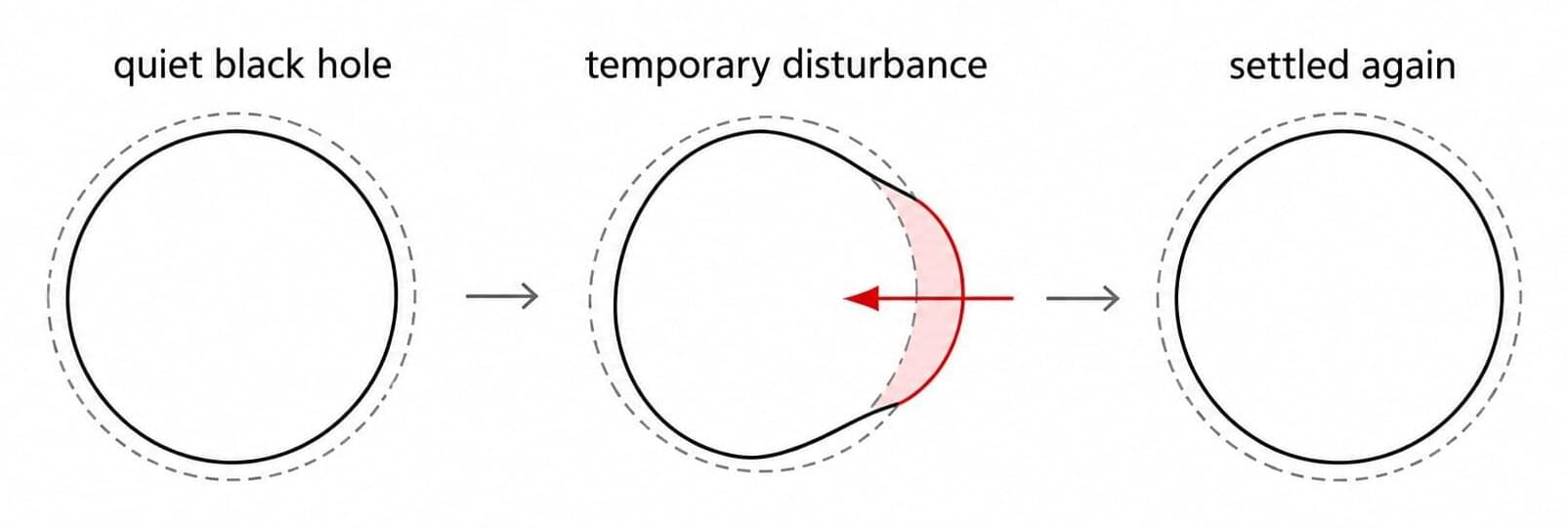
Black holes, despite their extreme nature, are described by surprisingly few basic parameters: their mass, charge and spin. Two black holes may have formed for completely different reasons and passed through very different histories, yet still end up in the same final state. John Wheeler summarized this idea with the famous phrase “black holes have no hair.”
Once quantum physics enters the picture, things become more complicated. As Stephen Hawking showed in the 1970s, black holes have a temperature and produce what we now call Hawking radiation. For a stationary black hole, this radiation has a characteristic temperature related to the surface gravity.
The real universe is much less ideal. Finding a completely isolated black hole is not easy. Matter may fall toward it, a nearby companion may disturb the surrounding spacetime, or external fields may change. For some period of time, the black hole can therefore be away from its quiet stationary state.